-

STMicroelectronics reported second-quarter 2026 revenue of $3.49 billion, a 26% increase from the same period last year, driven by stronger demand in its Automotive and Consumer, Embedded Processing and Connectivity (CECP) businesses. The company also reported improving order trends across all end markets and raised its revenue outlook for AI data center applications.
For the second quarter ended June 27, 2026, ST reported:
- Revenue of $3.49 billion
- Gross margin of 34.8% (35.2% on a non-U.S. GAAP basis)
- Operating income of $187 million
- Net income of $222 million, or $0.24 per diluted share
- Non-U.S. GAAP net income of $291 million, or $0.31 per diluted share
According to the company, second-quarter revenue exceeded the midpoint of its guidance, while gross margin was in line with expectations.
ST said demand strengthened further during the quarter, supported by strong bookings across all end markets. The company also reported improved supply visibility, tightening availability in several product categories, and distribution inventory levels that have fallen below its normal target.
For the third quarter of 2026, ST expects:
- Revenue of approximately $3.70 billion
- Sequential revenue growth of about 6.2%
- Year-over-year revenue growth of about 16.2%
- Gross margin of approximately 37.0%, including around 70 basis points of unused capacity charges
Looking ahead, the company expects revenue growth to accelerate in the fourth quarter, driven primarily by customer programs in AI data centers and low Earth orbit (LEO) satellite communications. ST forecasts fourth-quarter revenue to exceed $4 billion, resulting in second-half revenue growth above its typical seasonal pattern.
Reflecting continued strong demand from AI infrastructure, ST also increased its revenue outlook for its data center business. The company now expects data center revenue to exceed $1 billion in 2026 and projects revenue to grow to well above $2 billion in 2027, assuming current market conditions and customer engagements continue.
The revised outlook highlights the growing contribution of AI infrastructure to ST’s business, alongside continued demand from automotive, industrial, and communications markets.
Original – STMicroelectronics
-

Navitas Semiconductor and Magnachip Semiconductor have announced a strategic partnership to accelerate the adoption of silicon carbide (SiC) technologies in high-voltage (HV) and ultra-high-voltage (UHV) power applications. Under the agreement, Magnachip will license Navitas’ GeneSiC™ Trench-Assisted Planar (TAP) technology to expand its power semiconductor portfolio into the SiC market.
The licensing agreement covers GeneSiC technologies with voltage ratings of 1200 V, 2300 V, 3300 V, and higher, enabling Magnachip to develop SiC devices for next-generation high-power conversion systems.
As part of the collaboration, Magnachip will also gain access to Navitas’ established SiC supply chain and materials ecosystem to support faster product development and market entry. The companies plan to transfer, qualify, and internalize the licensed technology at Magnachip’s manufacturing facility in South Korea while maintaining compatibility with Navitas’ existing technology platform.
The partnership targets a broad range of high-power applications, including:
- Energy transmission and grid infrastructure
- Battery energy storage systems (BESS)
- Industrial electrification
- Automotive power systems
- High-voltage power conversion
- Ultra-high-voltage power electronics
The companies stated that the agreement extends beyond the current SiC licensing arrangement, with additional areas of collaboration expected to be announced in the future.
For Navitas, the partnership expands the reach of its GeneSiC technology into the high-voltage power semiconductor market through licensing and technology collaboration. For Magnachip, the agreement provides a pathway into the rapidly growing SiC market, complementing its existing MOSFET and power semiconductor portfolio while enabling the development of higher-voltage, higher-efficiency power conversion solutions.
Original – Magnachip Semiconductor
-

Texas Instruments (TI) reported second-quarter 2026 revenue of $5.46 billion, up 23% from the same period last year and 13% sequentially, driven by broad-based demand across the industrial, data center, and automotive markets. Net income increased 53% year-over-year to $1.98 billion, while diluted earnings per share reached $2.14, including a $0.05 benefit that was not included in the company’s original guidance.
For the quarter ended June 30, 2026, TI reported:
- Revenue of $5.46 billion
- Operating profit of $2.31 billion
- Net income of $1.98 billion
- Diluted earnings per share of $2.14
- Gross performance supported by continued demand across its core end markets
The Analog segment generated revenue of $4.37 billion, an increase of 26% year-over-year, while Embedded Processing revenue rose 16% to $788 million. Revenue from the company’s Other segment declined 2% to $310 million.
TI continued to generate strong cash flow during the quarter. Cash flow from operations reached $8.67 billion over the trailing 12 months, up 35% from a year earlier, while free cash flow increased to $6.53 billion. During the same period, the company invested $3.9 billion in research and development and selling, general and administrative expenses, spent $3.3 billion on capital expenditures, and returned $5.8 billion to shareholders through dividends and share repurchases.
For the third quarter of 2026, Texas Instruments expects:
- Revenue between $5.65 billion and $6.15 billion
- Diluted earnings per share between $2.23 and $2.57
The results reflect continued strength in TI’s industrial and automotive businesses, alongside growing demand from AI data center infrastructure, while the company’s ongoing investment in 300 mm manufacturing capacity continues to support profitability and cash generation.
Original – Texas Instruments
-

Soitec reported first-quarter fiscal 2027 revenue of €113 million, up 23% year-over-year at constant currency and scope, exceeding its guidance of approximately 15% growth. The stronger-than-expected performance was driven by rapidly increasing demand for Photonics-SOI substrates used in high-speed optical transceivers for AI data centers, prompting the company to publish its quarterly results ahead of schedule.
Photonics-SOI sales doubled compared with the same period last year as hyperscale AI infrastructure continued to expand. The company also announced that its 300 mm SOI manufacturing facility in Singapore has been qualified for high-volume production with its first customers, while additional customer qualifications are underway to support further capacity expansion.
Revenue by end market for the first quarter was:
- Edge & Cloud AI: €65 million, up 46% year-over-year
- Mobile Communications: €39 million, down 10%
- Automotive & Industrial: €10 million, up 108% from a low comparison base
The Edge & Cloud AI business accounted for approximately 57% of total quarterly revenue and remained the company’s primary growth driver. Demand was supported by increasing deployment of optical interconnect technologies, including pluggable transceivers, Near-Package Optics (NPO), and the industry’s ongoing qualification of Co-Packaged Optics (CPO) architectures for AI data centers.
Soitec said it continues to strengthen long-term visibility through multi-year capacity reservation agreements with customers, supported by cash deposits and extending beyond fiscal 2027. The company is expanding production capacity to meet accelerating demand for Photonics-SOI substrates.
Within Mobile Communications, Piezoelectric-on-Insulator (POI) adoption continued to increase, although ongoing inventory corrections in RF-SOI and weakness in the smartphone market offset these gains. In the Automotive & Industrial segment, Power-SOI and automotive FD-SOI wafer sales increased year-over-year, supported by higher shipment volumes and long-term customer agreements.
Looking ahead, Soitec expects second-quarter fiscal 2027 revenue to grow more than 30% year-over-year, driven primarily by continued acceleration in Photonics-SOI demand.
The company also upgraded its outlook for its AI-related business, forecasting that Photonics-SOI revenue will more than double in fiscal 2027 compared with the slightly above $100 million generated in fiscal 2026, assuming no significant disruption in the AI market.
Capital expenditure guidance remains unchanged, with projected fiscal 2027 cash outflows of approximately €100 million.
The results highlight the growing importance of silicon-on-insulator substrates for AI optical interconnects as hyperscale data centers transition toward higher-bandwidth, lower-latency optical networking technologies.
Original – Soitec
-

Micro Commercial Components (MCC) has introduced the MCACLD70N04YHE3-TP, a 40 V N-channel power MOSFET qualified to the AEC-Q101 automotive reliability standard. Designed for high-current automotive power systems, the device combines ultra-low on-resistance with high current capability and efficient thermal performance, making it suitable for electric vehicles, battery management systems, and power distribution applications.
Built on advanced Split Gate Trench (SGT) MOSFET technology, the MCACLD70N04YHE3-TP delivers a maximum RDS(on) of just 0.7 mΩ at a gate-source voltage of 10 V, helping reduce conduction and switching losses while improving overall system efficiency.
The MOSFET supports a continuous drain current of up to 350 A and features an ultra-low junction-to-case thermal resistance of 0.4°C/W, enabling efficient heat dissipation under high-load operating conditions. The device is housed in a compact DFN5060-C package, supporting high power density while minimizing PCB footprint.
With a 40 V drain-source voltage rating, the MCACLD70N04YHE3-TP is optimized for 12 V and 24 V automotive power architectures and is intended for a range of high-current power applications, including:
- Battery management systems (BMS)
- DC-DC converters
- Power distribution modules
- Motor drives
- Load switches
- Automotive power systems
Key specifications include:
- 40 V drain-source voltage
- AEC-Q101 qualification
- Maximum RDS(on) of 0.7 mΩ at VGS = 10 V
- Continuous drain current up to 350 A
- Split Gate Trench (SGT) MOSFET technology
- Junction-to-case thermal resistance of 0.4°C/W
- DFN5060-C package
Original – Micro Commercial Components
-

Micro Commercial Components (MCC) has expanded its silicon carbide portfolio with the introduction of the SICX0165G4JQ-TP, a 650 V, 1 A Silicon Carbide (SiC) Schottky Barrier Diode qualified to the AEC-Q101 automotive reliability standard. The device is designed for high-voltage automotive and industrial power conversion applications requiring high switching efficiency, compact size, and robust thermal performance.
The SICX0165G4JQ-TP combines a 650 V reverse voltage rating with a 1 A average forward current in a compact SMA package. Built using silicon carbide technology, the diode features zero reverse recovery current, eliminating reverse recovery losses to reduce switching losses and electromagnetic interference (EMI) while improving overall power conversion efficiency.
The device also offers a maximum forward voltage of 1.3 V to minimize conduction losses and an 18 A surge current capability to withstand inrush currents and transient overload conditions. Its positive temperature coefficient improves current sharing during parallel operation, while a maximum junction temperature of 175°C enables reliable operation in harsh environments with reduced cooling requirements.
The diode is targeted at a range of high-voltage power applications, including switching mode power supplies (SMPS), power factor correction (PFC) circuits, automotive auxiliary power supplies, EV charging systems, motor drives, and solar inverters.
Key specifications include a 650 V reverse voltage rating, 1 A average forward current, AEC-Q101 qualification, zero reverse recovery current, 1.3 V maximum forward voltage, 18 A surge current capability, 175°C maximum junction temperature, positive temperature coefficient, SMA package, and RoHS compliance.
Original – Micro Commercial Components
-

Efficient Power Conversion (EPC) will showcase its latest Gen7 gallium nitride (GaN) power technology at PCIM Asia 2026 in Shenzhen, highlighting new devices and reference designs for AI data centers, humanoid robots, drones, motor drives, and high-density DC-DC power conversion. The company will also present live technical sessions covering emerging GaN applications and future power architectures.
EPC’s seventh-generation eGaN® FETs are designed to deliver:
- Ultra-low on-resistance (RDS(on))
- Reduced switching losses
- High-frequency operation
- Improved thermal performance
- Higher power density
- Simplified system integration
The new devices target applications requiring compact, high-performance power conversion, particularly AI infrastructure and intelligent motion systems.
A key focus of EPC’s exhibition will be integrated GaN motor-drive ICs for robotics and electric propulsion.
Featured products include:
- EPC33110 three-phase integrated ePower Stage IC for humanoid robot joints and drone propulsion
- EPC23108/09 integrated ePower Stage ICs supporting up to 100 V and 35 A
- EPC23110/11 integrated ePower Stage ICs supporting up to 100 V and 20 A
The devices are now in mass production and are designed to accelerate deployment of intelligent motion control systems.
EPC will also present several new Gen7 discrete GaN transistors, including:
Device Voltage RDS(on) EPC2366 40 V 0.84 mΩ EPC2379 18 V 0.28 mΩ EPC2370 18 V 0.28 mΩ EPC2378 25 V 0.41 mΩ EPC2377 40 V 0.50 mΩ EPC2375 100 V 0.90 mΩ EPC2376 150 V 1.50 mΩ The devices target:
- AI power supplies
- High-density DC-DC converters
- Robotics
- Advanced motor drives
- High-current synchronous rectification
EPC will demonstrate GaN-based power conversion across the AI server power chain, including:
- EPC91123 – 6 kW isolated 800 V-to-12.5 V ISOP LLC converter
- EPC91134 – 11 kW isolated 400/800 V-to-50 V converter
- A new 800 V-to-6 V, 6 kW ISOP converter making its debut at the exhibition
The company will also showcase point-of-load (PoL) power architectures that efficiently convert 48 V and 12 V intermediate bus voltages to sub-1 V processor supply rails required by next-generation AI accelerators.
Visitors will see GaN-based reference designs powering:
- Humanoid robotic arms
- Drone propulsion systems
- Three-phase motor drives
- High-current inverter platforms
Featured reference designs include:
- EPC91122
- EPC91132
- EPC91121
- EPC91135
- EPC9186HCx
- EPC91128/29/30/31
These demonstrations highlight the advantages of GaN in applications requiring fast transient response, lightweight designs, and high power density.
During PCIM Asia 2026, EPC experts will present a series of technical sessions covering:
- The future evolution of GaN technology
- Scalable motor-control architectures for humanoid robots and drones
- New GaN products for high-density DC-DC converters
- Emerging AI power delivery architectures
Original – Efficient Power Conversion
-
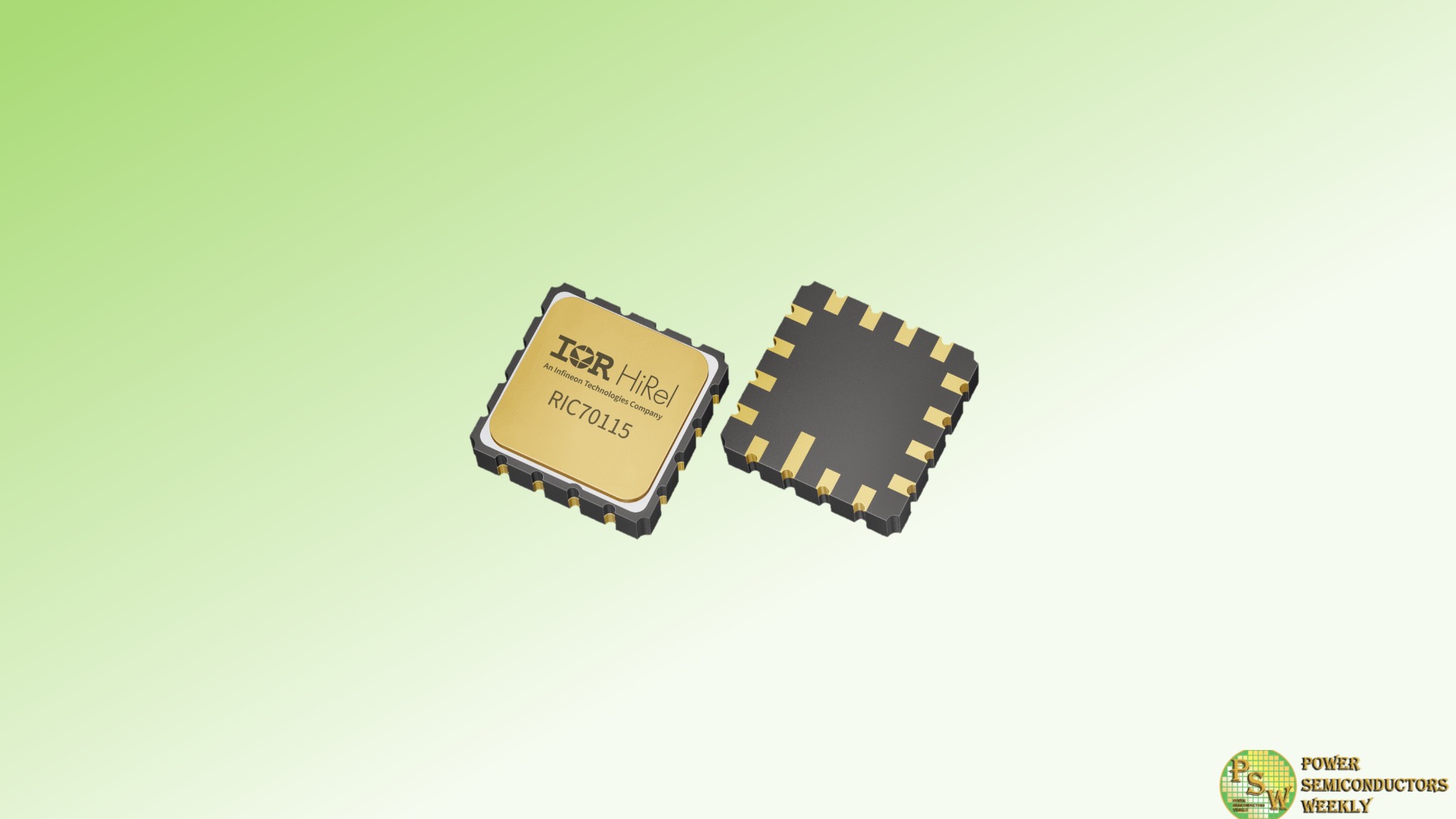
Infineon Technologies has introduced the RIC70115, a radiation-hardened gallium nitride (GaN) high-electron mobility transistor (HEMT) gate driver designed for satellite and other high-reliability space applications. The new device supports both GaN and silicon (Si) MOSFETs, providing spacecraft power system designers with greater flexibility to develop high-efficiency power conversion architectures for next-generation space platforms.
As satellite constellations expand and New Space missions demand higher power density and efficiency, GaN power devices are increasingly replacing conventional silicon technologies. The RIC70115 is designed to facilitate this transition by supporting both low-side and high-side gate drive configurations while maintaining reliable operation across a wide range of supply voltages.
The RIC70115 incorporates several integrated functions aimed at simplifying power converter design and improving system robustness:
- Independent Miller Clamp to prevent parasitic turn-on while maintaining fast switching performance
- Truly Differential Input (TDI) architecture for high immunity to common-mode noise, electromagnetic interference (EMI), and radio frequency interference (RFI)
- Integrated low-dropout (LDO) regulator generating a regulated 4.8 V gate-drive supply
- Input voltage range of 4.75 V to 15 V, supporting both 5 V and 12 V power rails
These integrated features reduce external component count, simplify circuit design, and improve long-term reliability in high-cycle space power systems.
The RIC70115 is qualified to meet the requirements of MIL-PRF-38535 and is designed for operation in harsh radiation environments.
Key specifications include:
- Operating temperature range: -55°C to +125°C
- Total Ionizing Dose (TID): up to 100 krad (Si)
- Single Event Effects (SEE) characterized up to a Linear Energy Transfer (LET) of 81.9 MeV·cm²/mg
These ratings make the device suitable for applications in low Earth orbit (LEO) as well as more demanding space missions.
The RIC70115 is intended for high-reliability space power systems, including:
- Satellite power distribution
- Spacecraft DC-DC converters
- Satellite power conditioning units
- Payload power supplies
- Deep-space and exploration missions
- Other radiation-tolerant power conversion applications
Original – Infineon Technologies
-

WeEn Semiconductors has introduced a new family of silicon carbide (SiC) power modules designed for solid-state transformers (SSTs), EV ultra-fast chargers, smart grids, and renewable energy systems. The portfolio includes more than 20 AC-DC and DC-DC power modules with voltage ratings from 1200 V to 2300 V, targeting the growing demand for high-efficiency, medium-voltage power conversion.
Solid-state transformers are gaining momentum as an enabling technology for AI data centers, grid modernization, and electrification, offering conversion efficiencies of approximately 98% while reducing system size and improving power management.
WeEn’s new SiC modules support a broad range of SST topologies, including power conversion from 35 kVAC medium-voltage AC directly to 800 VDC for applications such as AI server power infrastructure.
The new product family includes devices optimized for multiple converter architectures:
- 3-level topology modules for improved electromagnetic interference (EMI) performance
- 2-level topology modules for simplified control and reduced system footprint
- Half-bridge modules for LLC and Dual Active Bridge (DAB) converter stages
- Modules for both primary and secondary power conversion
Package options include:
- B2
- B3
- 62 mm screw-mount
- High-power PCB-mount configurations
The portfolio covers a wide operating range with:
- 1200 V
- 1500 V
- 1700 V
- 2300 V
Devices offer RDS(on) values as low as 1.5 mΩ, enabling lower conduction losses and improved overall system efficiency.
The modules feature:
- Low-inductance package design
- Simplified PCB layout
- Space for gate-driver integration
- Enhanced electrical isolation
- Flexible pin configurations
WeEn also offers customization options, including variations in:
- Direct bonded copper (DBC) substrates
- Module case materials
- Silicone gel encapsulation
- Mounting configurations
- Pin types
- Surface plating
- Pre-applied thermal interface materials
The new SiC module family is intended for a wide range of high-voltage power systems, including:
- Solid-state transformers (SSTs)
- AI data center power infrastructure
- Smart grids
- Renewable energy systems
- EV ultra-fast charging stations
- Medium-voltage power conversion
- Industrial power supplies
The initial portfolio includes more than 20 modules, including:
Device Breakdown Voltage RDS(on) Application INPC modules include WMSC5R0N17B3T 1700 V 5.0 mΩ Multi-purpose half-bridge B3 modules include WMSC5R0HS23B3T 2300 V AC side WMSC5R0F23B3T 2300 V AC side, LLC/DAB Primary WMSC3R0F15B3T 1500 V LLC/DAB Primary WMSC3R0F12B3T 1200 V LLC/DAB Secondary WMSC2R4F12B3T 1200 V LLC/DAB Secondary Half-bridge B2 Modules include WMSC4R0H23B2N 2300 V 4.0 mΩ LLC/DAB Secondary WMSC4R8H23B2N-D 2300 V 4.8 mΩ LLC/DAB Secondary WMSC6R0H12B2N-D 2300 V 6.0 mΩ LLC/DAB Secondary Half-bridge 62 mm module (screw mount) include WMSC2R7H23T2 2300 V 2.7 mΩ AC side WMSC2R7H17T2N-D 1700 V 2.7 mΩ LLC/DAB Primary WMSC7R5H17T2N-D 1700 V 7.5 mΩ LLC/DAB Secondary WMSC1R9H12T2 1200 V 1.9 mΩ LLC/DAB Secondary WMSC1R9H12T2N 1200 V 1.9 mΩ LLC/DAB Secondary High-power half-bridge modules (PCB mount) include WMSC1R5H12B3S 1200 V 1.5 mΩ LLC/DAB Secondary WMSC2R3H12B3S 1200 V 2.3 mΩ LLC/DAB Secondary WMSC4R0H12B2S 1200 V 4.0 mΩ LLC/DAB Secondary WMSC4R0H12B2S-D 1200 V 4.0 mΩ LLC/DAB Secondary WMSC4R0H12B2T-D 1200 V 4.0 mΩ LLC/DAB Secondary The new SiC power modules are available for sampling and volume production. With support for voltages up to 2300 V, multiple converter topologies, and customizable configurations, the portfolio is designed to address a broad range of medium-voltage power conversion applications as adoption of solid-state transformers and high-efficiency DC infrastructure continues to expand.
Original – WeEn Semiconductors
-

Efficient Power Conversion (EPC) will participate in Tech Taipei Power 2026, where the company will present its latest gallium nitride (GaN) power technologies for applications including AI data centers, industrial systems, automotive, robotics, and renewable energy. The event will bring together industry experts to discuss advances in power conversion technologies and next-generation power architectures.
A keynote presentation by Alex Lidow, CEO of EPC, will examine emerging trends in AI data center power systems and the technologies required to support rapidly increasing computing workloads.
The presentation will explore how eGaN® FETs and integrated GaN power solutions improve efficiency and performance across the power conversion chain, from high-voltage AC-DC conversion to point-of-load power delivery.
At the conference, EPC will demonstrate how GaN technology delivers advantages over conventional silicon-based power devices, including:
- Higher power conversion efficiency
- Increased power density
- Faster switching speeds
- Smaller power system designs
- Reduced energy losses
These benefits are becoming increasingly important as AI infrastructure demands higher power levels while maintaining energy efficiency.
EPC will highlight GaN solutions for a range of applications, including:
- AI data centers
- Industrial power supplies
- Robotics
- Electric mobility
- Renewable energy systems
- High-performance power conversion
The company will also showcase its latest reference designs and discuss application-specific power system requirements with engineers and system designers attending the event.
Original – Efficient Power Conversion


