-

The U.S. Department of War’s Office of Strategic Capital (OSC) has announced a $75 million conditional loan commitment to Halo Industries to support the expansion of domestic silicon carbide (SiC) wafer manufacturing using the company’s proprietary laser-based wafer slicing technology.
The proposed government financing is expected to attract an additional $75 million in private capital, bringing the combined public and private financing associated with the initiative to $150 million.
The investment is intended to accelerate Halo’s manufacturing expansion in Santa Clara, California, and strengthen U.S. supply chains for SiC semiconductor materials used in power electronics, defense systems and AI infrastructure.
Halo Industries specializes in laser-based wafering technology designed to separate silicon carbide wafers from crystal ingots without relying on conventional mechanical diamond-wire sawing.
According to the company, its proprietary manufacturing process significantly reduces material waste while increasing production throughput by up to tenfold compared with traditional wafer slicing methods.
The technology is intended to address two major challenges in SiC substrate manufacturing: the high cost of producing wafers and the loss of valuable crystalline material during conventional cutting processes.
Silicon carbide is a particularly challenging material to process because of its high hardness, which contributes to the time, equipment requirements and material losses associated with mechanical wafer slicing.
By using laser technology to separate wafers from SiC ingots, Halo aims to improve material utilization, increase manufacturing productivity and reduce the cost of finished semiconductor substrates.
These improvements could support the broader adoption of SiC power devices in applications requiring high efficiency, high voltage capability and reliable operation under demanding conditions.
The Office of Strategic Capital identified the domestic availability of SiC wafers as a strategic priority for the U.S. semiconductor supply chain.
SiC materials are used in power semiconductor devices and other electronic components supporting high-voltage defense applications, including advanced radar systems, electronic warfare equipment, hypersonic platforms and directed energy systems.
The material is also important for commercial applications such as electric vehicles, renewable energy conversion, industrial power electronics and AI data center infrastructure.
The proposed financing comes amid concerns about international competition and the increasing reliance of U.S. manufacturers on overseas semiconductor material suppliers.
According to OSC, foreign government subsidies have placed significant competitive pressure on domestic SiC wafer producers, creating challenges for U.S. manufacturing economics.
The agency stated that the financing would help Halo expand domestic production capacity and move toward cost parity with international competitors.
David A. Lorch, Director of the Office of Strategic Capital and Senior Advisor to Deputy Secretary of War Steve Feinberg, said Halo’s laser wafering technology could help establish more cost-effective domestic SiC supply chains.
Lorch also highlighted the potential for the manufacturing expansion to improve U.S. competitiveness in the global silicon carbide market.
Jordan B. Sebold, Senior Managing Director of Investments at OSC, emphasized that the conditional loan commitment is intended to mobilize private investment alongside government financing.
According to Sebold, strengthening domestic SiC wafer production is important for high-voltage power electronics, AI infrastructure and national security applications.
Matthew Haberlach, Senior Vice President of Investments at OSC, identified secure access to advanced semiconductor materials as an important requirement for defense manufacturing.
He stated that supporting domestic SiC wafer production and specialized laser manufacturing capabilities would help address vulnerabilities in the U.S. defense industrial supply chain.
The proposed investment also aligns with the Trump administration’s stated objective of expanding domestic manufacturing capacity for strategically important technologies.
Emil Michael, Under Secretary of War for Research and Engineering, described the initiative as part of broader efforts to strengthen domestic microelectronics manufacturing and reduce dependence on foreign supply chains.
The $75 million government financing remains conditional and has not yet reached financial close.
Halo must satisfy several requirements before the loan can be finalized, including financial, legal, technical, investment and due diligence conditions.
The announcement does not specify the planned expansion’s annual wafer production capacity, supported wafer diameters or expected completion date.
It also does not disclose the identities of the private investors expected to provide the additional $75 million.
If completed, the financing would support the industrial scaling of an alternative SiC wafer manufacturing process at a time when substrate costs and manufacturing efficiency remain important factors in the competitiveness of silicon carbide power semiconductor technology.
The project represents a potential expansion of the U.S. SiC materials supply chain, with Halo’s laser-based wafering process positioned to improve production economics while supporting demand from defense, industrial and commercial power electronics markets.
Original – U.S. Department of War
-
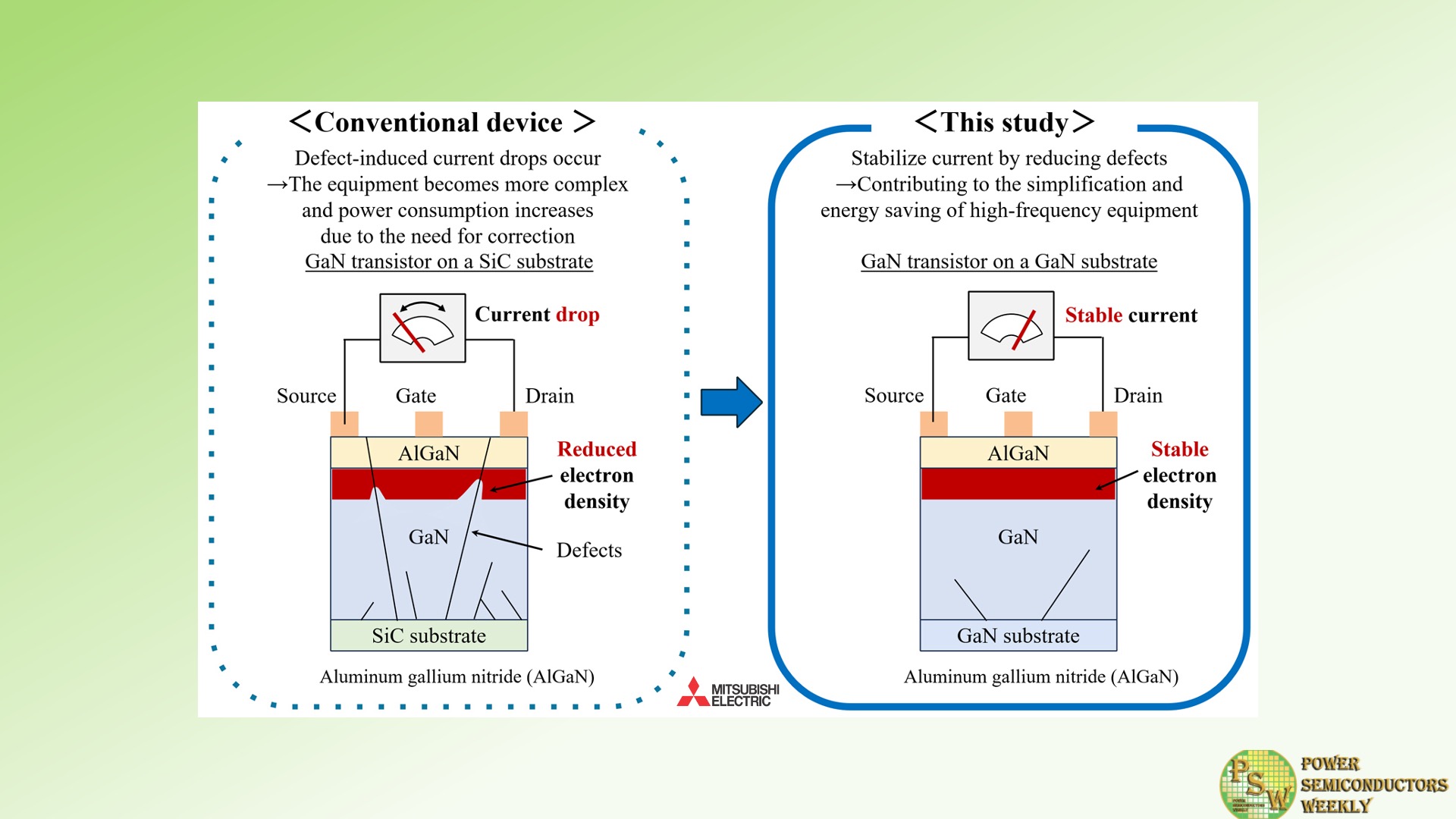
Mitsubishi Electric has announced a breakthrough in gallium nitride (GaN) transistor technology, demonstrating that frequency dispersion caused by crystal defects can be significantly suppressed by fabricating high-frequency transistors using GaN epitaxial layers grown on GaN substrates.
The company stated that it has identified the effects of crystal defects on frequency dispersion in GaN-on-GaN transistors and demonstrated substantially flatter frequency characteristics, potentially enabling more efficient and compact high-frequency electronic systems.
According to Mitsubishi Electric, the achievement represents the first demonstration of its kind worldwide, based on a review of published research conducted in October 2026.
The development targets high-power, high-efficiency GaN transistors used in industrial microwave heating equipment, next-generation wireless communication infrastructure and radar systems.
Demand for GaN devices in these applications is increasing as equipment manufacturers seek higher operating efficiency, improved high-frequency performance and reduced system power consumption.
One application highlighted by Mitsubishi Electric is industrial microwave heating for chemical recycling, where high-frequency energy is used in processes that convert waste plastics into chemical raw materials.
The research was conducted as part of a project commissioned by Japan’s Ministry of the Environment, which supports the development and deployment of technologies intended to reduce carbon dioxide emissions.
Mitsubishi Electric has participated in the ministry’s project for accelerating the implementation of innovative CO2-reduction components and materials since 2024, focusing on high-efficiency GaN transistor technologies.
Conventional high-frequency GaN transistors are commonly manufactured by growing a GaN epitaxial layer on a silicon carbide (SiC) substrate.
SiC offers high thermal conductivity, making it suitable for dissipating heat generated during high-power transistor operation.
However, the use of different materials for the substrate and epitaxial layer creates challenges during crystal growth.
According to Mitsubishi Electric, crystal defects arising from this material mismatch can interfere with electron transport during high-frequency operation.
These defects contribute to frequency dispersion, a phenomenon in which transistor current and other electrical characteristics vary depending on operating frequency.
Frequency-dependent changes in transistor behavior can reduce operating stability and complicate the design of high-frequency electronic systems.
To compensate for these effects, conventional equipment may require sophisticated digital correction circuits, adding complexity, increasing system size and contributing to additional power consumption.
Mitsubishi Electric investigated an alternative device structure in which the GaN epitaxial layer is grown directly on a GaN substrate.
Using the same semiconductor material for both the substrate and epitaxial layer offers a route to reducing the crystal defects associated with heteroepitaxial growth on SiC.
The company developed a circuit analysis method that incorporates the electrical response of crystal defects, allowing researchers to evaluate how these defects influence transistor frequency characteristics.
Through device characterization and the new analysis approach, Mitsubishi Electric identified the relationship between crystal defects and frequency dispersion in GaN-on-GaN transistors.
The research demonstrated that frequency dispersion could be significantly suppressed, resulting in flatter frequency characteristics.
According to the company, the improved frequency stability could reduce the need for complex digital correction circuitry in high-frequency equipment.
Simplifying these circuits could contribute to smaller electronic systems, improved overall performance and lower power consumption.
The results are particularly relevant to high-frequency power electronics, where transistor efficiency and stable electrical characteristics are important for maintaining performance across operating conditions.
Potential applications include industrial microwave heating systems, 5G and 6G wireless base stations, and radar equipment.
Mitsubishi Electric also emphasized the importance of GaN substrate technology, an area in which Japanese semiconductor manufacturers and materials suppliers have established capabilities.
The achievement highlights the potential of GaN-on-GaN device structures to address limitations associated with conventional GaN-on-SiC high-frequency transistors.
While the research demonstrates improved frequency characteristics, Mitsubishi Electric has not disclosed quantitative frequency dispersion measurements, transistor output power, efficiency figures or a timetable for commercial deployment.
The company will present details of the development at the International Workshop on Nitride Semiconductors 2026 (IWN2026), taking place November 8–13 at Kumamoto Castle Hall in Kumamoto, Japan.
The research represents a further development in GaN semiconductor technology aimed at improving the performance and efficiency of high-frequency power devices, particularly in applications where stable transistor characteristics can help simplify system-level electronics.
Original – Mitsubishi Electric
-

onsemi has confirmed that it will not proceed with its previously announced plan to expand silicon carbide (SiC) semiconductor manufacturing at its Rožnov pod Radhoštěm facility in the Czech Republic. The decision, reached in agreement with the Czech Ministry of Industry and Trade, reflects changes in global SiC market conditions and project economics since the investment was first announced in June 2024.
The original project involved a multi-year brownfield investment of up to $2 billion to establish end-to-end silicon carbide production at onsemi’s existing Rožnov manufacturing site.
The proposed expansion was intended to strengthen the company’s manufacturing capabilities for advanced SiC power semiconductors, which are used in applications requiring high efficiency, power density and thermal performance.
However, onsemi and the Czech government have now agreed to discontinue the expansion project following a reassessment of market conditions and the economics of the planned investment.
The company emphasized that the decision is specifically related to developments in the global silicon carbide market and does not reflect concerns about the Czech Republic’s investment environment.
Existing manufacturing operations at Rožnov will continue without interruption, including the site’s established silicon and silicon carbide production capabilities.
The facility remains part of onsemi’s global semiconductor manufacturing network and will continue supporting customers across automotive, industrial and other power electronics markets.
onsemi also confirmed that it expects to continue investing in its Czech operations, including its facilities in Rožnov pod Radhoštěm and Brno.
The company anticipates further hiring and investment at both locations to support growth opportunities in automotive electronics, industrial applications, AI data centers and emerging semiconductor markets.
The Czech Republic therefore remains an important manufacturing and development location within onsemi’s global operations, despite the cancellation of the planned SiC capacity expansion.
Karel Havlíček, First Deputy Prime Minister and Minister of Industry and Trade of the Czech Republic, stated that the decision reflects the current situation in the global semiconductor market.
Havlíček emphasized that the continuation of existing manufacturing operations in Rožnov is particularly important and welcomed onsemi’s intention to pursue additional investments in the country.
He also highlighted the company’s ongoing research and development activities in the Czech Republic, alongside its established semiconductor manufacturing operations.
The original June 2024 announcement represented a significant proposed investment in European silicon carbide manufacturing capacity, with the objective of creating an integrated production capability for advanced power semiconductor devices.
The decision not to proceed removes that planned expansion from onsemi’s investment program but does not affect its existing SiC manufacturing operations in the country.
The announcement comes as the company continues to evaluate its manufacturing investments against changing demand conditions and business opportunities across its target markets.
onsemi has not disclosed any financial charges associated with the cancellation or provided revised capital expenditure figures for its Czech operations.
The company reiterated that its long-term commitment to the Czech Republic remains unchanged, with future investment focused on opportunities across automotive, industrial, AI data center and emerging applications.
Original – onsemi
-

Sansha Electric Manufacturing Co., Ltd. (SanRex) reported a 29.4% year-over-year increase in semiconductor sales for the first half of fiscal 2026, supported by growing demand for power semiconductor devices used in inverter applications and investment in artificial intelligence data centers.
According to the company’s financial results published on November 6, 2026, consolidated revenue for the six months ended September 30, 2026, reached ¥12.80 billion, representing an increase of 10.1% from ¥11.63 billion in the corresponding period of fiscal 2025.
Operating profit increased to ¥500 million, compared with ¥68 million a year earlier, representing growth of 630.3%. The consolidated operating margin improved to 3.9% from 0.6%.
Ordinary profit reached ¥431 million, compared with ¥70 million in the prior-year period, an increase of 511.6%.
Profit attributable to owners of the parent company amounted to ¥243 million, compared with a net loss of ¥29 million in the first half of fiscal 2025.
Earnings per share improved to ¥18.30 from a loss of ¥2.24 per share a year earlier.
The semiconductor segment was a major contributor to revenue growth, generating sales of ¥3.87 billion, compared with ¥2.99 billion in the corresponding period of fiscal 2025.
Sansha Electric attributed the 29.4% increase in semiconductor revenue primarily to stronger sales for inverter applications, driven by robust capital investment in AI and data center infrastructure.
Within the semiconductor segment, power module sales increased by 30.0% to ¥2.30 billion, compared with ¥1.77 billion a year earlier.
Revenue from semiconductor wafers and chips rose by 16.1% to ¥706 million, compared with ¥608 million in the prior-year period.
Discrete semiconductor products and other devices recorded the strongest percentage growth within the segment, with revenue increasing by 41.2% to ¥856 million, compared with ¥606 million a year earlier.
Despite the significant increase in semiconductor sales, the segment remained unprofitable due to rising material and outsourcing costs.
The semiconductor operating loss narrowed to ¥100 million from ¥264 million in the first half of fiscal 2025. The segment’s operating margin improved to negative 2.6%, compared with negative 8.9% a year earlier.
Sansha Electric’s power supply segment generated revenue of ¥8.94 billion, representing growth of 3.5% from ¥8.64 billion in the corresponding period of fiscal 2025.
Operating profit in the power supply business increased by 80.2% to ¥600 million, compared with ¥333 million a year earlier. The segment’s operating margin improved to 6.7% from 3.9%.
The company reported stronger orders for its surface treatment power supplies used in high-density printed circuit board manufacturing.
Revenue from surface treatment power supplies increased by 24.1% to ¥1.78 billion, compared with ¥1.43 billion in the prior-year period.
Sales of small power supplies rose by 11.3% to ¥3.00 billion, while industrial power supply revenue increased by 7.3% to ¥1.54 billion.
Maintenance services also recorded substantial growth, with revenue increasing by 83.9% to ¥775 million, compared with ¥421 million a year earlier.
Sansha Electric attributed the increase in maintenance revenue to growing demand for servicing solar power conditioners, which are used in photovoltaic power conversion systems.
However, not all product categories recorded growth. Revenue from inverter products declined by 25.4% to ¥592 million, while sales of other power supplies decreased by 32.6% to ¥1.25 billion.
The company’s analysis of operating profit showed that higher sales contributed ¥685 million to the year-over-year improvement, while changes in contribution margin added ¥87 million.
These positive factors were partially offset by a ¥329 million increase in fixed costs and a ¥12 million negative impact from inventory fluctuations.
Foreign exchange movements contributed approximately ¥105 million to the year-over-year improvement in operating profit.
The average exchange rate for the U.S. dollar increased to ¥159.37 from ¥146.04 in the corresponding period of fiscal 2025, while the Chinese yuan increased to ¥23.52 from ¥20.30.
At the end of September 2026, Sansha Electric reported total assets of ¥32.48 billion, compared with ¥32.72 billion at the end of the previous fiscal year.
Total liabilities declined to ¥7.64 billion from ¥7.80 billion, while net assets amounted to ¥24.84 billion, compared with ¥24.93 billion previously.
The company’s equity ratio improved slightly to 76.5% from 76.2%, while its reported net cash flow measure increased to ¥4.65 billion from ¥4.56 billion.
The results highlight the contrasting performance of Sansha Electric’s two main businesses. Semiconductor revenue growth was supported by demand associated with AI and data center investment, although higher production-related costs continued to weigh on profitability.
Meanwhile, the power supply segment delivered stronger operating earnings, supported by demand for high-density PCB manufacturing equipment and solar power system maintenance services.
Original – Sansha Electric Manufacturing
-
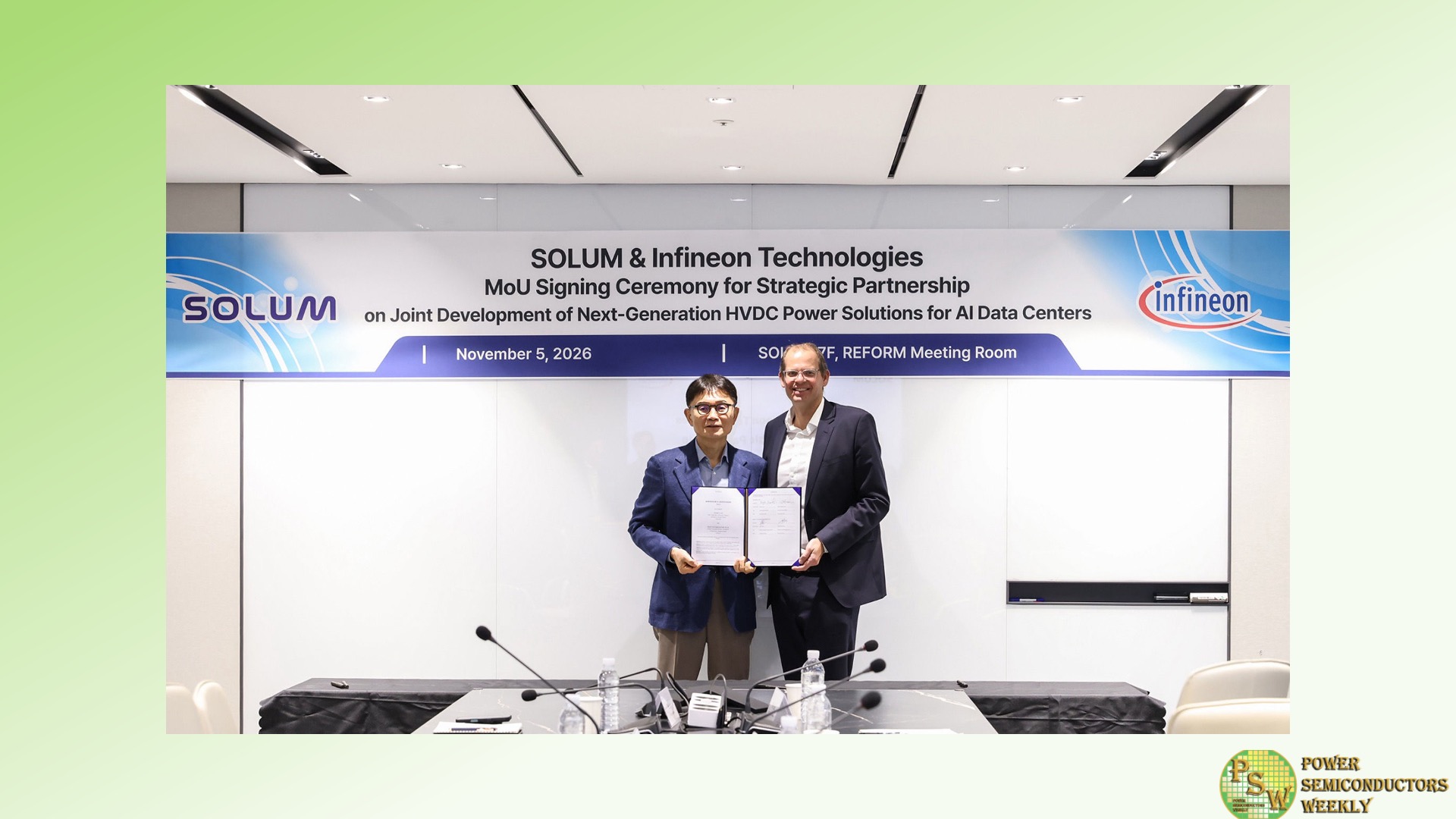
Infineon Technologies and South Korean power electronics specialist SOLUM have signed a Memorandum of Understanding (MoU) to strengthen their collaboration on high-voltage direct current (HVDC) power solutions for next-generation artificial intelligence data centers.
The agreement builds on the companies’ existing technical cooperation and focuses on three key applications within AI data center power infrastructure: intermediate bus converters (IBCs), battery backup units (BBUs) and power supply units (PSUs).
The collaboration comes as generative AI and high-performance computing applications drive increasing power requirements in data centers, creating demand for more efficient power conversion and distribution technologies.
HVDC power architectures are emerging as an approach to addressing these requirements by reducing conversion losses, improving power distribution efficiency and supporting higher system reliability.
Under the agreement, Infineon and SOLUM intend to combine their respective capabilities in power semiconductor technology, system design and power electronics manufacturing to explore high-efficiency HVDC solutions for AI infrastructure.
Infineon will contribute its expertise in power semiconductors and power system architectures, while SOLUM will provide its experience in server power supplies, power module design and manufacturing.
Adam White, Division President Power Systems at Infineon, highlighted the increasing importance of efficiency, reliability and power density in AI data center infrastructure.
White stated that SOLUM’s server power capabilities complement Infineon’s semiconductor portfolio, providing a basis for developing next-generation HVDC power solutions.
SOLUM CEO Jun Sung-ho emphasized that the rapid development of artificial intelligence is transforming not only computing requirements but also the electrical infrastructure supporting AI systems.
According to Jun, the collaboration will help SOLUM strengthen its high-voltage and high-efficiency power design capabilities while exploring additional opportunities in the AI data center power market.
Infineon plans to participate from the early stages of relevant development projects, working with SOLUM to evaluate suitable semiconductor technologies, system architectures and product solutions.
The company will also provide reference designs and technical support to assist with the development and implementation of HVDC power systems.
Infineon’s technology portfolio includes silicon, silicon carbide (SiC) and gallium nitride (GaN) power semiconductor devices, enabling the companies to evaluate different switching technologies according to the efficiency, voltage and power density requirements of specific applications.
Relevant product families include Infineon’s CoolMOS and OptiMOS silicon MOSFETs, CoolSiC silicon carbide devices and CoolGaN gallium nitride transistors.
The collaboration will also draw on Infineon’s PSOC microcontrollers and sensing technologies, which can support monitoring, control and protection functions in power conversion systems.
Intermediate bus converters, battery backup units and power supply units are important components of data center electrical infrastructure, supporting power distribution, voltage conversion and continuity of operation.
By targeting these applications, the companies aim to address multiple stages of the power delivery architecture used in high-performance computing and AI server environments.
Infineon and SOLUM will maintain regular technical discussions to evaluate emerging technologies and coordinate development activities related to next-generation power systems.
The agreement also reflects Infineon’s efforts to strengthen its engagement with technology companies in South Korea, which the company identifies as an important market for AI infrastructure and advanced computing hardware.
Through the expanded partnership, Infineon and SOLUM intend to accelerate the development of HVDC power solutions that address the growing efficiency, power density and reliability requirements of AI data centers.
The companies have not disclosed financial terms, specific product launch dates or a commercialization timeline associated with the MoU.
Original – Infineon Technologies
-

CVD Equipment Corporation reported revenue of $1.6 million for the third quarter of 2026, a decline of 72.1% year-over-year, as the company advances its strategy to discontinue pursuing new equipment system orders and evaluate strategic alternatives for its remaining operations and assets.
The semiconductor equipment manufacturer confirmed that it will no longer seek new system orders for its CVD Equipment business. Instead, the company is focusing on completing its existing equipment backlog, fulfilling warranty obligations and maintaining its spare parts, quartz and services activities.
The strategic shift follows the company’s divestiture of its SDC business earlier in 2026, which strengthened its balance sheet and provided additional liquidity.
As part of the restructuring, CVD Equipment has further reduced its workforce to align operating costs with the requirements of its remaining business activities.
The company also engaged commercial real estate services firm CBRE to market its owned properties in Central Islip and Saugerties, New York, for sale.
The planned property disposals form part of a broader effort to monetize company assets while the board continues evaluating strategic alternatives.
Lawrence J. Waldman, Chairman of CVD Equipment’s Board of Directors, stated that the company is pursuing a disciplined approach to asset monetization following the SDC divestiture.
According to Waldman, the strengthened balance sheet and absence of outstanding debt provide additional flexibility as the company assesses its future direction.
For the quarter ended September 30, 2026, revenue from continuing operations declined by 72.1% compared with the corresponding period of 2025, primarily reflecting lower equipment system revenue resulting from reduced order bookings.
Quarterly bookings totaled $0.7 million, compared with $1.0 million in the third quarter of 2025, reflecting lower demand for new systems.
The company’s equipment backlog decreased to $3.0 million at September 30, 2026, from $3.9 million at June 30, 2026.
Gross margin fell to 9.2%, compared with 32.0% in the prior-year quarter. The decline was primarily attributable to lower system revenue and the impact of fixed manufacturing costs on a significantly reduced revenue base.
An increase in non-system revenue partially offset the margin pressure, reflecting the continued contribution of spare parts, quartz products and services.
CVD Equipment recorded restructuring charges of $0.8 million during the quarter, primarily related to severance costs, asset impairments, and legal and board-related expenses associated with its decision to discontinue pursuing new system orders.
The company reported a net loss from continuing operations of $2.1 million, or $0.30 per basic and diluted share, compared with net income of $0.1 million, or $0.02 per share, in the third quarter of 2025.
The third-quarter loss from continuing operations included the $0.8 million restructuring charge.
Net income from discontinued operations amounted to $0.6 million, or $0.09 per basic and diluted share, primarily reflecting an adjustment to estimated income taxes payable associated with the SDC divestiture.
For the first nine months of 2026, income from discontinued operations totaled $14.6 million, including a $14.1 million net gain from the sale of SDC.
The company reported total net income of $9.4 million for the nine months ended September 30, 2026, reflecting the contribution from discontinued operations.
CVD Equipment ended the third quarter with $23.5 million in cash and cash equivalents, compared with $8.7 million at December 31, 2025. The increase was primarily attributable to proceeds from the SDC divestiture.
The company reported no outstanding debt at the end of September 2026.
Stockholders’ equity increased to $34.6 million from $24.7 million at the end of 2025.
Acting CEO Warren Cheesman stated that the company had taken additional steps to align its workforce and cost structure with current operating requirements.
Cheesman emphasized that CVD Equipment remains focused on completing outstanding equipment orders, meeting warranty commitments and supporting customers through its remaining spare parts, quartz and services business.
The company’s decision to stop pursuing new equipment system orders represents a significant change in its business strategy, shifting its priorities away from new system sales toward the completion of existing commitments and the evaluation of its remaining assets.
Original – CVD Equipment
-

Nexperia has confirmed that multiple legal proceedings are underway in the Netherlands and China involving the semiconductor manufacturer, Wingtech Technology and Nexperia China. The company is seeking approximately $2 billion in damages related to alleged disruptions to its business operations and corporate governance.
According to Nexperia, the disputes stem from developments beginning in October 2025, when Nexperia China, under Wingtech’s control, began operating outside the semiconductor manufacturer’s established corporate governance framework.
Nexperia alleges that these actions have materially affected its business operations and resulted in significant financial damages, currently estimated at $2 billion.
The company has initiated legal proceedings in the Netherlands against Wingtech, Nexperia China and Xuezheng Zhang, also known as Wing, seeking compensation for the alleged losses.
Nexperia also announced a ruling by the Court of The Hague concerning the enforcement of its intellectual property rights.
On November 2, 2026, the Dutch court granted an injunction requested by Nexperia, preventing Nexperia (China) Ltd. from relying on, enforcing or otherwise using a Chinese court judgment within the European Union if that judgment would restrict Nexperia’s ability to enforce its intellectual property rights.
Nexperia stated that the decision strengthens its position in the ongoing dispute and provides additional protection for its intellectual property within the European Union.
The company emphasized that Nexperia B.V. is the registered owner of intellectual property rights used throughout the group worldwide.
These rights include patents covering semiconductor products and manufacturing methods, as well as Nexperia trademarks.
The legal proceedings therefore concern not only the alleged financial impact of the governance dispute but also the company’s ability to protect and enforce intellectual property associated with its semiconductor technologies and manufacturing operations.
Despite the ongoing litigation, Nexperia stated that it continues to supply semiconductor products to customers and establish cooperation agreements with third parties.
The company is also working to expand and stabilize its global supply chain, with an emphasis on maintaining business continuity and protecting customer relationships.
Nexperia pointed to its recently announced third-quarter 2026 financial results as evidence of its operational resilience amid the disputes.
The manufacturer reiterated that its priorities remain protecting the business, serving customers and safeguarding its long-term interests.
The company has not disclosed a timetable for resolving the outstanding legal proceedings in the Netherlands and China.
The $2 billion damages figure represents Nexperia’s current estimate of losses and is the subject of its legal claims, rather than a court-awarded amount.
Original – Nexperia
-

Axcelis Technologies reported revenue of $237.8 million for the third quarter of 2026, representing an increase of 11.3% year-over-year. The semiconductor equipment manufacturer benefited from improving demand for ion implantation systems, record revenue from its Customer Service and Installed Base (CS&I) business, and stronger order activity across its end markets.
For the quarter ended September 30, 2026, revenue increased from $213.6 million in the corresponding period of 2025. Axcelis stated that its third-quarter financial performance exceeded expectations, supported by higher equipment shipments and continued growth in its aftermarket services business.
President and CEO Russell Low highlighted a broadening recovery in semiconductor equipment demand, with continued momentum in memory applications and increasing customer activity in the power semiconductor and general mature-node markets.
The company also reported a significant increase in bookings during the quarter, although it did not disclose the value of new orders in its financial announcement.
According to Low, the improving order environment reflects renewed customer investment across multiple semiconductor manufacturing segments. Axcelis expects the positive momentum to continue through the end of 2026 and anticipates further growth in 2027.
Third-quarter GAAP gross margin reached 41.0%, compared with 41.6% in the same period of 2025. Non-GAAP gross margin was 41.2%, compared with 41.8% a year earlier.
The company indicated that foreign exchange headwinds affected gross margin performance during the quarter, partially offsetting the benefits of stronger equipment shipments and record CS&I revenue.
GAAP operating margin was 11.5%, compared with 11.7% in the third quarter of 2025. Non-GAAP operating margin declined to 16.6% from 18.2% in the prior-year period.
Despite the slightly lower margins, Axcelis reported higher net earnings. GAAP net income increased to $37.8 million, compared with $26.0 million in the corresponding quarter of 2025, representing growth of approximately 45%.
GAAP diluted earnings per share increased to $1.21 from $0.83 a year earlier.
On a non-GAAP basis, net income reached $39.2 million, compared with $37.9 million in the third quarter of 2025. Non-GAAP diluted earnings per share increased to $1.26 from $1.21.
Adjusted EBITDA totaled $44.0 million, compared with $43.2 million in the prior-year quarter.
Axcelis also reported continued strength in its CS&I business, which achieved another quarterly revenue record. The segment benefits from the company’s installed base of ion implantation equipment and provides ongoing customer support and related services.
Senior Vice President and Interim CFO David Ryzhik stated that stronger shipments and record CS&I revenue supported the company’s better-than-expected quarterly results.
Ryzhik also highlighted Axcelis’ cash generation and balance sheet position, noting that the company continues to maintain financial flexibility as semiconductor equipment demand improves.
Axcelis is continuing to invest in next-generation semiconductor manufacturing technologies, including ion implantation solutions addressing evolving customer requirements across its target markets.
The company’s management identified memory, power semiconductors and general mature-node applications as areas showing improving customer investment activity.
For the fourth quarter of 2026, Axcelis expects revenue of approximately $275 million, representing a sequential increase of about 15.7% from the third quarter.
The company forecasts GAAP diluted earnings per share of approximately $1.15 and non-GAAP diluted earnings per share of approximately $1.50 for the fourth quarter.
The non-GAAP results exclude specified items, including share-based compensation, certain restructuring and severance expenses, and transaction and integration costs associated with the company’s previously announced merger agreement with Veeco Instruments.
Axcelis expects to close 2026 with improving demand conditions, supported by semiconductor manufacturing investment in memory, power devices and mature-node technologies, alongside continued growth in its installed-base services business.
Original – Axcelis Technologies
-

GlobalFoundries (GF) reported preliminary revenue of $1.899 billion for the third quarter of 2026, representing an increase of 13% year-over-year and 6% sequentially. The semiconductor foundry recorded higher gross and operating margins, supported by growth in communications infrastructure, data centers, automotive and industrial applications.
For the quarter ended September 30, 2026, GlobalFoundries reported an IFRS gross profit of $571 million, compared with $419 million in the same period of 2025. Gross margin increased to 30.1%, up 530 basis points year-over-year and 180 basis points sequentially.
Non-IFRS gross margin reached a record 31.4%, compared with 26.0% a year earlier and 29.9% in the previous quarter. Non-IFRS gross profit increased 36% year-over-year to $597 million.
IFRS operating profit reached $230 million, an increase of 18% year-over-year, with an operating margin of 12.1%. Non-IFRS operating profit rose 31% to $340 million, representing an operating margin of 17.9%.
Despite the improvement in operating performance, GlobalFoundries recorded an IFRS net loss of $270 million, equivalent to a diluted loss of $0.49 per share. This compared with net income of $249 million, or $0.44 per diluted share, in the third quarter of 2025.
The reported loss was primarily driven by a $441 million non-cash charge associated with the issuance of 9.9 million ordinary shares to the U.S. government in September 2026. The charge was recognized in non-operating expenses.
Excluding specified adjustments, non-IFRS net income increased 28% year-over-year to $298 million, while non-IFRS diluted earnings per share rose to $0.53 from $0.41.
Non-IFRS adjusted EBITDA reached $647 million, compared with $573 million a year earlier, representing a margin of 34.1%. Cash generated from operating activities totaled $341 million, down from $595 million in the prior-year quarter. Non-IFRS adjusted free cash flow was $136 million, compared with $451 million a year earlier.
GlobalFoundries shipped approximately 647,000 wafers on a 300mm-equivalent basis during the quarter, an increase of 7% year-over-year and 4% sequentially. The company ended September with approximately $3.2 billion in cash, cash equivalents and marketable securities.
CEO Tim Breen attributed the company’s performance to a higher-value product mix and growing demand for differentiated semiconductor technologies used in AI-related applications. GlobalFoundries reported particularly strong growth in communications infrastructure and data centers, alongside expansion in automotive and home and industrial IoT markets.
During the quarter, GlobalFoundries expanded its manufacturing agreement with Marvell to increase production capacity for high-performance silicon germanium (SiGe) technology at its Burlington, Vermont, facility. The additional capacity will support optical connectivity products, including pluggable optical transceivers, near-packaged optics and co-packaged optics for AI and cloud data centers.
GlobalFoundries also entered into a long-term manufacturing agreement with Monolithic Power Systems (MPS) in September 2026. Under the agreement, MPS will deploy its proprietary process technology at GlobalFoundries’ 300mm semiconductor manufacturing facility in Singapore.
Volume production under the MPS agreement is scheduled to begin in early 2027. The partnership targets high-performance power management semiconductors for next-generation automotive architectures, industrial robotics and automation, and smart power stages used in AI and cloud computing infrastructure.
In October 2026, GlobalFoundries announced a separate multiyear manufacturing agreement with TSMC valued at $2 billion. The agreement will establish U.S.-based manufacturing capacity for silicon interposers used in TSMC’s CoWoS advanced packaging ecosystem.
GlobalFoundries plans to expand production capacity at its Malta, New York, facility to support the agreement, with volume manufacturing expected to begin ramping during the first half of 2028. The silicon interposers will support advanced packaging requirements for AI and high-performance computing processors.
The company also announced an amendment to its existing U.S. CHIPS and Science Act award, reallocating $955 million in incentives to support semiconductor manufacturing investments in Malta, New York, and Burlington, Vermont.
The funding will support investments in silicon photonics, silicon germanium and advanced packaging technologies, including the establishment of a U.S.-based manufacturing source for silicon interposers.
In another October announcement, GlobalFoundries was selected as the technology provider and operator for two new semiconductor fabrication facilities at its Malta site under a U.S.-Japan initiative providing up to $21 billion in funding.
An initial investment of approximately $10 billion is intended to accelerate construction of a new 300mm semiconductor fabrication facility, with manufacturing capacity expected to become operational in 2029. GlobalFoundries will provide technology and operational expertise in exchange for management and technology fees over the life of the project.
For the fourth quarter of 2026, GlobalFoundries expects revenue of $2.0 billion, plus or minus $25 million. The company forecasts an IFRS gross margin of 30.7% and a non-IFRS gross margin of 31.5%, each with a range of plus or minus 100 basis points.
Fourth-quarter IFRS operating margin is projected at 16.4%, while non-IFRS operating margin is expected to reach 19.8%. GlobalFoundries forecasts IFRS diluted earnings per share of $0.47 and non-IFRS diluted earnings per share of $0.59, each with a range of plus or minus $0.05.
The company’s board of directors also approved a quarterly dividend of $0.12 per share, payable on January 14, 2027, to shareholders of record as of December 22, 2026.
Original – GlobalFoundries
-

Wolfspeed reported revenue of $155.0 million for the first quarter of fiscal 2027, exceeding the midpoint of its guidance range. The silicon carbide semiconductor manufacturer also announced a conditional $1.5 billion loan commitment from the U.S. Department of War and highlighted new supply agreements supporting its long-term manufacturing and technology strategy.
For the quarter ended September 27, 2026, revenue declined from $196.8 million in the corresponding period of fiscal 2026, representing a decrease of approximately 21%. However, the company reported sequential improvements in its adjusted gross margin and continued progress in its efforts to strengthen its financial position.
Wolfspeed’s Power Products business generated revenue of $116.8 million, compared with $131.8 million in the prior-year quarter. Materials Products revenue totaled $38.2 million, compared with $65.0 million a year earlier.
The company recorded a GAAP gross loss of $34.0 million, corresponding to a negative gross margin of 22%. This compared with a GAAP gross loss of $77.1 million and a negative gross margin of 39% in the prior-year period.
On a non-GAAP basis, gross margin improved to negative 13%, compared with negative 26% a year earlier. Wolfspeed also reported a sequential improvement of 710 basis points in its adjusted gross margin, supported by a slightly higher revenue base.
GAAP operating loss narrowed to $112.8 million, compared with $161.4 million in the corresponding quarter of fiscal 2026. The GAAP operating margin improved to negative 73%, from negative 82% a year earlier.
Non-GAAP operating loss amounted to $83.4 million, compared with $117.5 million in the previous-year quarter. The corresponding non-GAAP operating margin improved to negative 54%, from negative 60%.
Wolfspeed reported a GAAP net loss of $143.8 million, compared with a net loss of $643.6 million in the corresponding period of fiscal 2026. GAAP loss per share was $2.61, compared with $4.12 a year earlier.
The prior-year results included substantial reorganization-related charges associated with the company’s Chapter 11 proceedings. Wolfspeed emerged from Chapter 11 in September 2025 and subsequently adopted fresh-start accounting, meaning its current financial statements are not directly comparable with those reported before the restructuring.
On a non-GAAP basis, the company recorded a net loss of $111.4 million, compared with $85.2 million in the prior-year period. Non-GAAP loss per share was $2.03, compared with $0.55 a year earlier.
Adjusted EBITDA was negative $54.7 million, compared with negative $57.4 million in the first quarter of fiscal 2026.
Wolfspeed reported operating cash outflow of $84.2 million during the quarter, compared with positive operating cash flow of $5.7 million a year earlier. Free cash flow was negative $96.5 million, compared with negative $99.6 million in the prior-year period.
Capital expenditure on property and equipment declined substantially to $10.6 million, compared with $104.0 million in the corresponding quarter of fiscal 2026.
At September 27, 2026, Wolfspeed held $995.1 million in cash, cash equivalents and short-term investments, compared with $1.09 billion at the end of June 2026.
A major development during the quarter was the announcement of a conditional 30-year, $1.5 billion loan commitment from the U.S. Department of War. The proposed financing is intended to support the development of the domestic wide-bandgap semiconductor supply chain.
According to Wolfspeed, the financing could strengthen its capital structure and generate significant annual interest savings if completed. The commitment remains subject to conditions, including due diligence, definitive agreements and required government approvals.
CEO Robert Feurle described the financing commitment and the company’s recently announced supply agreements as important elements of Wolfspeed’s strategy to return to sustainable long-term growth.
Wolfspeed also expanded and extended its existing long-term silicon carbide wafer supply agreement with Infineon Technologies. The agreement, which previously covered 150mm SiC wafers, has been broadened to include 200mm wafers.
The expanded relationship supports Wolfspeed’s transition toward 200mm silicon carbide manufacturing, which is central to its strategy for improving production economics and supporting future demand for wide-bandgap semiconductor devices.
In power semiconductor applications, Wolfspeed announced a multiyear supply agreement with BorgWarner to provide silicon carbide devices for the automotive supplier’s next-generation 800V inverter platform.
The agreement extends Wolfspeed’s involvement in high-voltage automotive power electronics, where silicon carbide MOSFETs are used to improve power conversion efficiency and support electric vehicle drivetrain performance.
Wolfspeed also highlighted its growing engagement with the AI data center market, including recognition from power electronics manufacturer Megmeet through a Strategic Partner Award.
Beyond conventional power electronics, the company commercially introduced its proprietary TSiC technology, targeting applications in augmented reality, quantum computing and advanced optical systems.
For the second quarter of fiscal 2027, Wolfspeed expects revenue between $155 million and $175 million, representing a midpoint of $165 million.
The company is targeting further sequential improvement in non-GAAP gross margin, with the objective of approaching breakeven during the quarter.
Wolfspeed also expects second-quarter non-GAAP operating expenses of $65 million to $69 million.
CFO Gregor van Issum stated that the improvement in adjusted gross margin, together with the potential financial benefits of the conditional government loan, supports management’s view that fiscal 2027 could represent a turning point for the company.
Wolfspeed’s near-term priorities remain improving manufacturing efficiency, managing cash consumption, strengthening its financial position and expanding commercial relationships across silicon carbide materials and power semiconductor applications.
Original – Wolfspeed


