-
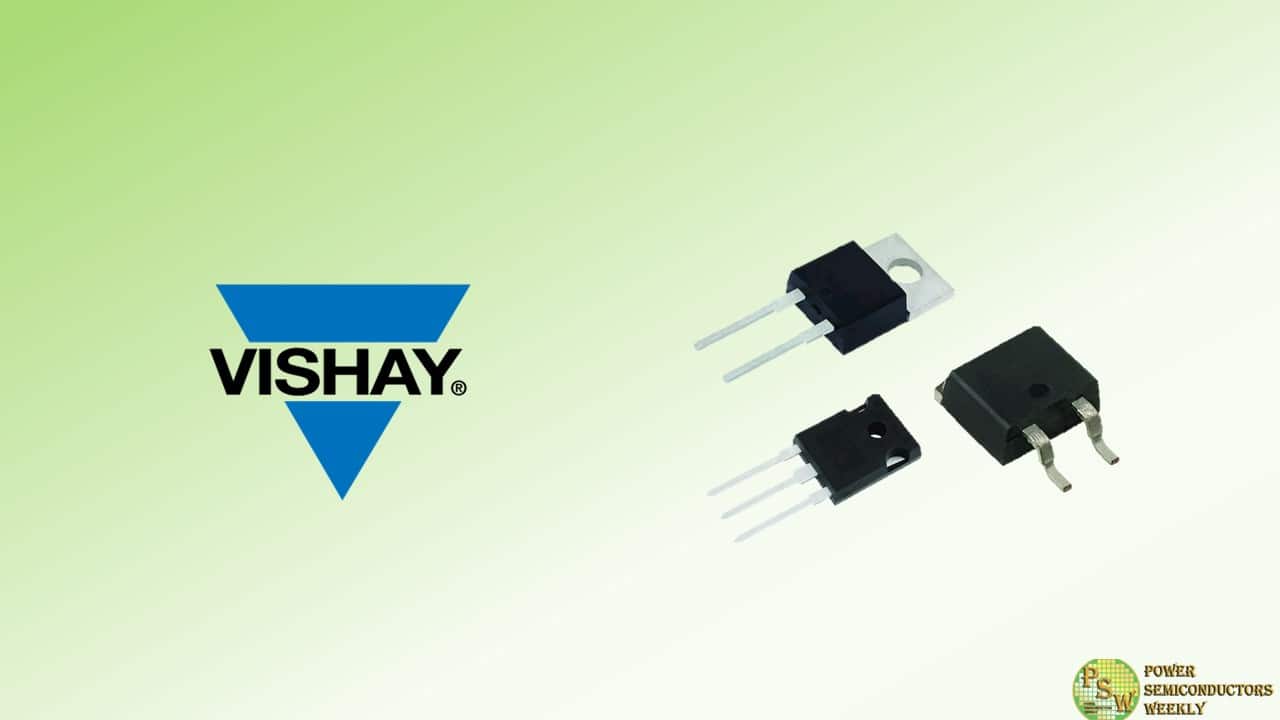
Vishay Intertechnology, Inc. introduced 16 new Gen 3 1200 V silicon carbide (SiC) Schottky diodes. Featuring a merged PIN Schottky (MPS) design, the Vishay Semiconductors devices combine high surge current robustness with low forward voltage drop, capacitive charge, and reverse leakage current to increase efficiency and reliability in switching power designs.
The next-generation SiC diodes released today consist of 5 A to 40 A devices in the TO-220AC 2L, TO-247AD 2L, and TO-247AD 3L through-hole and D2PAK 2L (TO-263AB 2L) surface-mount packages. The diodes offer a low capacitance charge down to 28 nC, while their MPS structure — which features a backside thinned via laser annealing technology — delivers a reduced forward voltage drop of 1.35 V. In addition, the devices’ low typical reverse leakage current down to 2.5 µA at 25 °C reduces conduction losses, ensuring high system efficiency during light loads and idling. Unlike ultrafast diodes, the Gen 3 devices have virtually no recovery tail, which further improves efficiency.
Typical applications for the diodes will include AC/DC PFC and DC/DC ultra high frequency output rectification in FBPS and LLC converters for solar power inverters; energy storage systems; industrial drives and tools; and datacenters. For the harsh environments of these applications, the devices combine operating temperatures to +175 °C with forward surge ratings to 260 A for high robustness. In addition, diodes in the D2PAK 2L package feature a molding compound with a high CTI ≥ 600, ensuring excellent electrical insultation at elevated voltages.
Offering high reliability, the RoHS-compliant and halogen-free devices have passed higher temperature reverse bias (HTRB) testing of 2000 hours and temperature cycling testing of 2000 thermal cycles.
Device Specification Table:
Part # IF(AV) (A) IFSM (A) VF at IF (V) QC (nC) Configuration Package VS-3C05ET12T-M3 5 42 1.35 28 Single TO-220AC 2L VS-3C10ET12T-M3 10 84 1.35 55 Single TO-220AC 2L VS-3C15ET12T-M3 15 110 1.35 81 Single TO-220AC 2L VS-3C20ET12T-M3 20 180 1.35 107 Single TO-220AC 2L VS-3C05ET12S2L-M3 5 42 1.35 28 Single D2PAK 2L VS-3C10ET12S2L-M3 10 84 1.35 55 Single D2PAK 2L VS-3C15ET12S2L-M3 15 110 1.35 81 Single D2PAK 2L VS-3C20ET12S2L-M3 20 180 1.35 107 Single D2PAK 2L VS-3C10EP12L-M3 10 84 1.35 55 Single TO-247AD 2L VS-3C15EP12L-M3 15 110 1.35 81 Single TO-247AD 2L VS-3C20EP12L-M3 20 180 1.35 107 Single TO-247AD 2L VS-3C30EP12L-M3 30 260 1.35 182 Single TO-247AD 2L VS-3C10CP12L-M3 2 x 5 42 1.35 28 Common cathode TO-247AD 3L VS-3C20CP12L-M3 2 x 10 84 1.35 55 Common cathode TO-247AD 3L VS-3C30CP12L-M3 2 x 15 110 1.35 81 Common cathode TO-247AD 3L VS-3C40CP12L-M3 2 x 20 180 1.35 107 Common cathode TO-247AD 3L Samples and production quantities of the new SiC diodes are available now, with lead times of 13 weeks.
Original – Vishay Intertechnology
-

Vishay Intertechnology, Inc. announced that at PCIM Europe 2024 the company will be showcasing its broad portfolio of power management solutions that address several increasingly important trends in power electronics, including e-mobility, high efficiency power conversion, energy storage, and grid management. In Hall 9, Booth 208, Vishay experts will be available to discuss the company’s extensive offering of passive and semiconductor solutions for these next-generation applications.
Taking center stage for Vishay at PCIM will be the company’s newly released 1200 V MaxSiC™ series silicon carbide (SiC) MOSFETs, which deliver on-resistances of 55 mW, 95 mW, and 280 mΩ in standard packages for industrial applications, with custom products also available.
In addition, Vishay will provide a roadmap for 650 V to 1700 V SiC MOSFETs with on-resistances ranging from 10 mΩ to 1 Ω. Vishay’s SiC platform is based on proprietary MOSFET technology — enabled through the company’s acquisition of MaxPower Semiconductor, Inc. — which will address market demands in traction inverter, photovoltaic energy conversion and storage, on-board charger, and charging station applications. At the booth, Vishay’s experts will also be discussing upcoming planned releases of the MaxSiC platform, including AEC-Q101 Automotive Grade products.
At PCIM, Vishay will be offering a variety of application-focused demonstrations, including:
- A high voltage intelligent battery shunt for 400 V and 800 V batteries
- A 40 kW resettable electronic fuse (eFuse) for 400 V and 800 V battery electric vehicles (BEV)
- A unidirectional, 11 kW three-phase AC on-board charger (OBC) with a BOM consisting of 90 % Vishay parts
- A bidirectional 10 kW eFuse for 48 V applicationsA collaborative robot workstation featuring Vishay power resistors, ESTA power electronic capacitors (PEC), Automotive Grade diodes, SiC MOSFETs, and an SiC-based auxiliary power converter.
Vishay passive components on display at PCIM will include IHPT series solenoid-based haptic actuators featuring Immersion Corporation licenses, a 5.5 kW transformer / inductor for LLC applications, and IHLE® series low profile, high current inductors with integrated e-field shields; wirewound resistors and charging resistors featuring hybrid wirewound technology; thick film power resistors; robust metallized polypropylene film capacitors, including AC and pulse capacitors and DC-Link capacitors with high temperature operation up to +125 °C and the ability to withstand temperature humidity bias (THB) testing of 85 °C / 85 % for 1000 h; X1, X2, and Y2 EMI suppression film capacitors certified to safety and humidity robustness grade IIIB; and DC and AC power electronic capacitors (PEC) with high impulse current ratings, low inductance, and high reliability.
Highlighted Vishay semiconductor solutions will consist of surface-mount diodes in the eSMP® and FlatPAK 5×6 packages; leadless surface-mount diodes in the DFN, CLP, and LLP series packages; and 650 V and 1200 V SiC Schottky diodes up to 20 A in eSMP® series and 40 A in power packages for AC/DC power factor correction (PFC) and ultra high frequency output rectification. In addition, Vishay will be showcasing microBUCK® and microBRICK® buck regulators, including the 60 V input SiC967 synchronous buck regulator with integrated power MOSFETs and inductors; high voltage MOSFETs in the PowerPAK 10×12 package; automotive power modules in the EMIPAK 1B, MaacPAK, FlatPAK, and HC0 packages; and industrial power modules in Gen III TO-244, IAP, SOT-227, and MTC packages.
Prior to the exhibition, on June 9, Vishay’s Sanjay Havanur — senior manager of system applications — will be presenting the seminar “Silicon Is Still Here: A Refresher on the Narrow Bandgap Power MOSFETs and Their Datasheets” at 2 p.m. in the Arvena Park Hotel. During the show, Claudio Damilano — director of product marketing and market development, power modules — will present “Evolution in Vishay Power Modules for E-Mobility: Solutions for High Voltage and Low Voltage Applications” on June 11, at 3:50 p.m. in Hall 6, Booth 220.
Original – Vishay Intertechnology
-
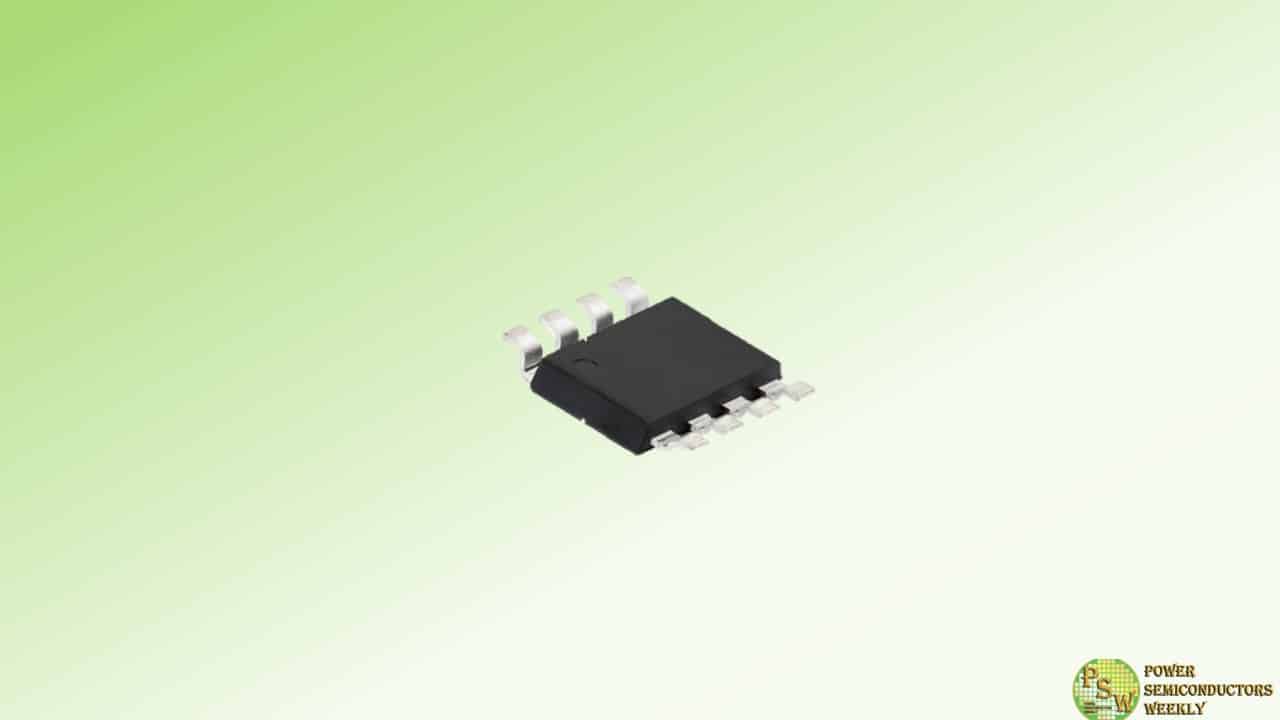
To provide higher efficiency and power density for telecom, industrial, and computing applications, Vishay Intertechnology, Inc. introduced its first fourth-generation 600 V E Series power MOSFET in the new PowerPAK® 8 x 8LR package.
Compared to previous-generation devices, the Vishay Siliconix n-channel SiHR080N60E slashes on-resistance by 27 % and resistance times gate charge, a key figure of merit (FOM) for 600 V MOSFETs used in power conversion applications, by 60 % while providing higher current in a smaller footprint than devices in the D²PAK package.
Vishay offers a broad line of MOSFET technologies that support all stages of the power conversion process, from high voltage inputs to the low voltage outputs required to power the latest high tech equipment. With the SiHR080N60E and other devices in the fourth-generation 600 V E Series family, the company is addressing the need for efficiency and power density improvements in two of the first stages of the power system architecture — power factor correction (PFC) and subsequent DC/DC converter blocks.
Typical applications will include servers, edge computing, super computers, and data storage; UPS; high intensity discharge (HID) lamps and fluorescent ballast lighting; telecom SMPS; solar inverters; welding equipment; induction heating; motor drives; and battery chargers.
Measuring 10.42 mm by 8 mm by 1.65 mm, the SiHR080N60E’s compact PowerPAK 8 x 8LR package features a 50.8 % smaller footprint than the D²PAK while offering a 66 % lower height. Due to its top-side cooling, the package delivers excellent thermal capability, with an extremely low junction to case (drain) thermal resistance of 0.25 °C/W.
This allows for 46 % higher current than the D²PAK at the same on-resistance level, enabling dramatically higher power density. In addition, the package’s gullwing leads provide excellent temperature cycle capability.
Built on Vishay’s latest energy-efficient E Series superjunction technology, the SiHR080N60E features low typical on-resistance of 0.074 Ω at 10 V and ultra low gate charge down to 42 nC. The resulting FOM is an industry-low 3.1 Ω*nC, which translates into reduced conduction and switching losses to save energy and increase efficiency in power systems > 2 kW.
For improved switching performance in hard-switched topologies such as PFC, half-bridge, and two-switch forward designs, the MOSFET released today provides low typical effective output capacitances Co(er) and Co(tr) of 79 pF and 499 pF, respectively. The package also provides a Kelvin connection for improved switching efficiency.
The device is RoHS-compliant and halogen-free, and it is designed to withstand overvoltage transients in avalanche mode with guaranteed limits through 100 % UIS testing.
Original – Vishay Intertechnology
-

Vishay Intertechnology, Inc. issued the following statement from its Board of Directors in response to the press release issued on April 22, 2024 by Mountaineer Partners Management, LLC (“Mountaineer”) in which Mountaineer published its letter to the Board of Directors urging the Board to consider adopting and implementing a $600 million accelerated share repurchase.
Vishay regularly engages with our stockholders and welcomes constructive input focused on enhancing value. Vishay’s CEO has held numerous discussions with Mountaineer since his appointment to the position on January 1, 2023, and the senior management team met with stockholders most recently at the company’s Investor Day held on April 2, 2024.
Vishay’s Board appreciates and is carefully evaluating the suggestion made by Mountaineer along with input from other stockholders to determine the course of action that is in the best interest of the company and all stockholders.
Original – Vishay Intertechnology
-
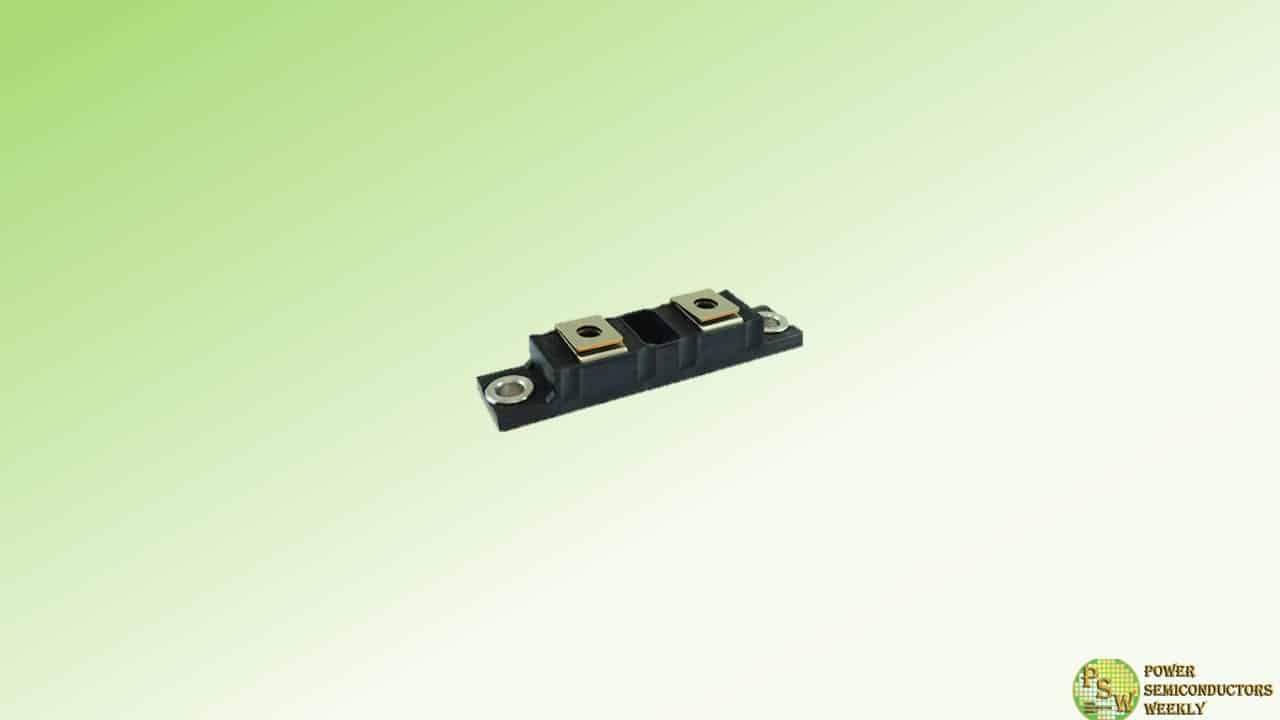
Vishay Intertechnology, Inc. introduced two new FRED Pt® 500 A Ultrafast soft recovery diode modules in the new TO-244 Gen III package. Offering higher reliability than previous-generation solutions, the Vishay Semiconductors VS-VSUD505CW60 and VS-VSUD510CW60 are designed to reduce losses and EMI / RFI in high frequency power conditioning systems.
The rugged TO-244 package of the diode modules released today withstands 46 000 IOL cycles at given conditions, offering an improved life expectancy over previous-generation devices. In addition, the industry-standard package is footprint-compatible with competing solutions in the TO-244 to provide a drop-in replacement for existing designs.
The VSUD505CW60 and VS-VSUD510CW60 are ideally suited for high frequency welding; high current converters and ballast water management systems (BWMS) in railway equipment, cranes, and ships; UPS; and other applications where switching losses comprise a significant portion of the total losses. In these applications, the softness of their recovery eliminates the need for a snubber, reducing component counts and lowering costs.
Offered in a common cathode configuration, the diode modules provide low forward voltage drop down to 0.82 V, thermal resistance — junction to case — of 0.16 °C/W, and an operating temperature range up to +175 °C.
Device Specification Table:
Part number VS-VSUD505CW60 VS-VSUD510CW60 VR (V) 600 IF(AV) (A) 500 Qrr typical (nC) 460 1770 trr (ns) 178 270 VFM @ 250 A, +175 °C (V) 0.95 0.82 RthJC per diode (°C/W) 0.160 Package TO-244 Samples and production quantities of the new FRED Pt® soft recovery diode modules are available now, with lead times of 26 weeks.
Original – Vishay Intertechnology
-

The Specialty Thin Film (STF) division of Vishay Intertechnology, Inc. announced that its Electro-Films (EFI) factory in Warwick, Rhode Island, has been certified to the IATF 16949:2016 quality standard for the IGBR family of back contact wirebondable gate resistors, designed to reduce noise in silicon carbide (SiC) MOSFET power modules.
Based on ISO 9001:2015 — with additional automotive customer-specific requirements — IATF 16949:2016 is the global technical specification and quality management standard for the automotive industry. With this certification, the quality management system at the EFI Warwick factory is now certified to ISO 9001:2015 for all products, and IATF 16949:2016 for IGBR resistors. In addition, its environmental management system is certified to ISO 14001:2015 and ISO 45001:2018.
Original – Vishay Intertechnology
-

Vishay Intertechnology, Inc. and Nexperia B.V. announced in November 2023 that they had entered into an agreement that Vishay will acquire Nexperia’s wafer fabrication facility and operations located in Newport, South Wales, U.K.
At the time of that announcement, the closing of Newport wafer fab transaction was subject to UK government review, the purchase rights of a third party, and customary closing conditions. Nexperia is pleased to announce that all conditions to the sale have now been met and the sale of Newport wafer fab to Vishay is now finalised, today, 6th March, securing a future for its employees and for the site.
Original – Nexperia
-
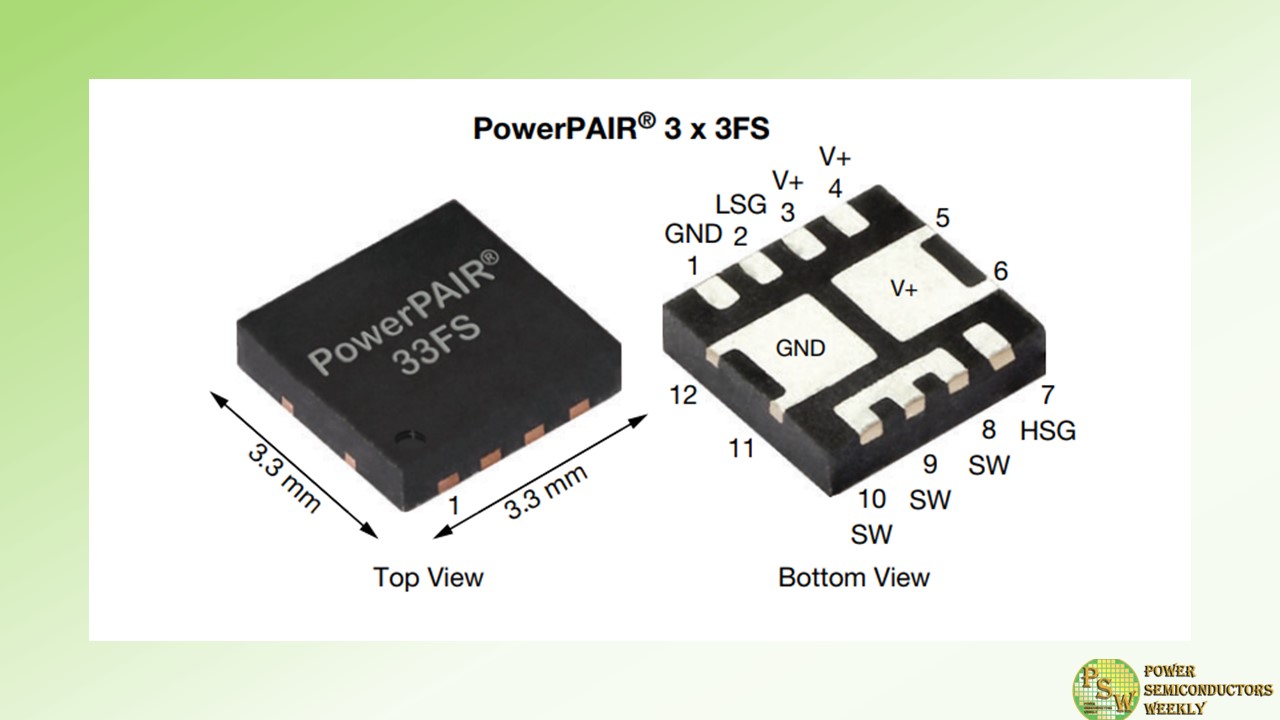
Vishay Intertechnology, Inc. introduced a new 80 V symmetric dual n-channel power MOSFET that combines high and low side TrenchFET® Gen IV MOSFETs in a single 3.3 mm by 3.3 mm PowerPAIR® 3x3FS package. For power conversion in industrial and telecom applications, the Vishay Siliconix SiZF4800LDT increases power density and efficiency, while enhancing thermal performance, reducing component counts, and simplifying designs.
This dual MOSFET can be used in place of two discrete devices typically specified in the PowerPAK 1212 package — saving 50 % board space. The device provides designers with a space-saving solution for synchronous buck converters, point of load (POL) converters, and half- and full-bridge power stages for DC/DC converters in radio base stations, industrial motor drives, welding equipment, and power tools. In these applications, the high and low side MOSFETs of the SiZF4800LDT form an optimized combination for 50 % duty cycles, while its logic level turn-on at 4.5 V simplifies circuit driving.
To increase power density, the MOSFET offers best in class on-resistance down to 18.5 mW typical at 4.5 V. This is 16 % lower than the closest competing device in the same package dimensions. For increased efficiency in high frequency switching applications, the SiZF4800LDT offers a low on-resistance times gate charge — a key figure of merit (FOM) for MOSFETs used in power conversion applications — of 131mW*nC and on-resistance times gain-drain charge
The device’s flip-chip technology enhances thermal dissipation — resulting in 54 % lower thermal resistance compared to competing MOSFETs. The SiZF4800LDT’s combination of low on-resistance and thermal resistance results in a continuous drain current of 36 A, which is 38 % higher than the closest competing device. The MOSFET features a unique pin configuration that enables a simplified PCB layout and supports shortened switching loops to minimize parasitic inductance. The SiZF4800LDT is 100 % Rg- and UIS-tested, RoHS-compliant, and halogen-free.
Competitor Comparison Table:
Part number SiZF4800LDT (New) Competitor SiZF4800LDTPerformance improved Package PowerPAIR 3x3FS PowerPAIR 3x3FS Dimensions (mm) 3.3 x 3.3 x 0.75 3.3 x 3.3 x 0.75 – Configuration Symmetric dual Symmetric dual – VDS (V) 80 80 – VGS (V) ± 20 ± 20 – RDS(on) (mΩ) @ 4.5 VGS Typ. 18.5 22 +16 % Max. 23.8 29 +18 % Qg (nC) @ 4.5 VGS Typ. 7.1 6.0 – FOM – 131 132 +1 % ID (A) Max. 36 26 +38 % RthJC (C/W) Max. 2.2 4.8 +54 % Original – Vishay Intertechnology
-

Vishay Intertechnology, Inc. announced that at the Applied Power Electronics Conference and Exposition (APEC) 2024, the company is showcasing its broad portfolio of passive and semiconductor solutions that address the latest trends in power electronics — from energy harvesting, electric vehicle (EV) powertrains, and mass commercialization to efficient and effective power electronics for power tools and switching regulators that shorten the iterative design cycle.
Taking center stage in booth 1607 will be Vishay’s newly released 1200 V MaxSiC™ series silicon carbide (SiC) MOSFETs, which deliver on-resistances of 40, 80 and 250 mΩ in standard packages for industrial applications, with custom products also available. In addition, Vishay will provide a roadmap for 650 V to 1700 V SiC MOSFETs with on-resistances ranging from 12 mΩ to 1 Ω.
Vishay’s SiC platform is based on a proprietary MOSFET technology — enabled through the company’s recent acquisition of MaxPower Semiconductor, Inc. — which will address market demands in traction inverter, photovoltaic energy storage, on-board charger, and charging station applications. At the booth, Vishay’s experts will also be discussing upcoming planned releases of the MaxSiC platform, including AEC-Q101 Automotive Grade products.
At APEC 2024, Vishay will also be offering a variety of product-focused demonstrations highlighting IHPT haptic actuators; the THJP ThermaWick® Thermal Jumper; the pulse performance of MELF, CRCW / CRCW-HP thick film, and MCS, MCU, and MCW thin film chip resistors; and the thermal capabilities of the PCAN and RCP high power thin and thick film resistors. In addition, application-focused demonstrations will include:
- An 800 V SiC MOSFET heat pump with a 100 % Vishay BOM
- A high voltage intelligent battery shunt for 400 V and 800 V batteries
- A six-phase DC/DC converter for mild hybrid vehicles with 48 V boardnets that provides power to 12 V loads up to 3 kW with high efficiency to 97 %
- A semiconductor-based, resettable eFuse for 800 V electric vehicle systems
Additional Vishay passive components on display at APEC 2024 will include the IHDM series of high current, edge-wound through hole inductors with continuous operation to +180 °C; hybrid planar and integrated transformers; wireless charging coils; NTC thermistors and PTC thermistors, including the PTCEL series capable of handling energy absorption up to 240 J; high power wirewound, thin film, and thick film resistors, including the anti-surge RCS with power to 0.5 W in the 0805 case size; high voltage thick film resistors and dividers; high voltage aluminum, ceramic, and power electronic capacitors (PEC); high energy tantalum capacitors; and robust metallized polypropylene film capacitors, including the MKP1848e DC-Link capacitor with high temperature operation to +125 °C.
Highlighted Vishay semiconductor solutions will consist of the SiC967 high voltage synchronous buck regulator with integrated power MOSFETs and inductors; 400 V, 600 V, and 1200 V standard rectifiers in SlimDPAK 2L and SMPD 2L packages with high creepage distance; 650 V and 1200 V SiC Schottky diodes up to 12 A in eSMP® series and power packages for AC/DC power factor correction (PFC) and ultra high frequency output rectification; and transient voltage suppressors (TVS).
Original – Vishay Intertechnology
-
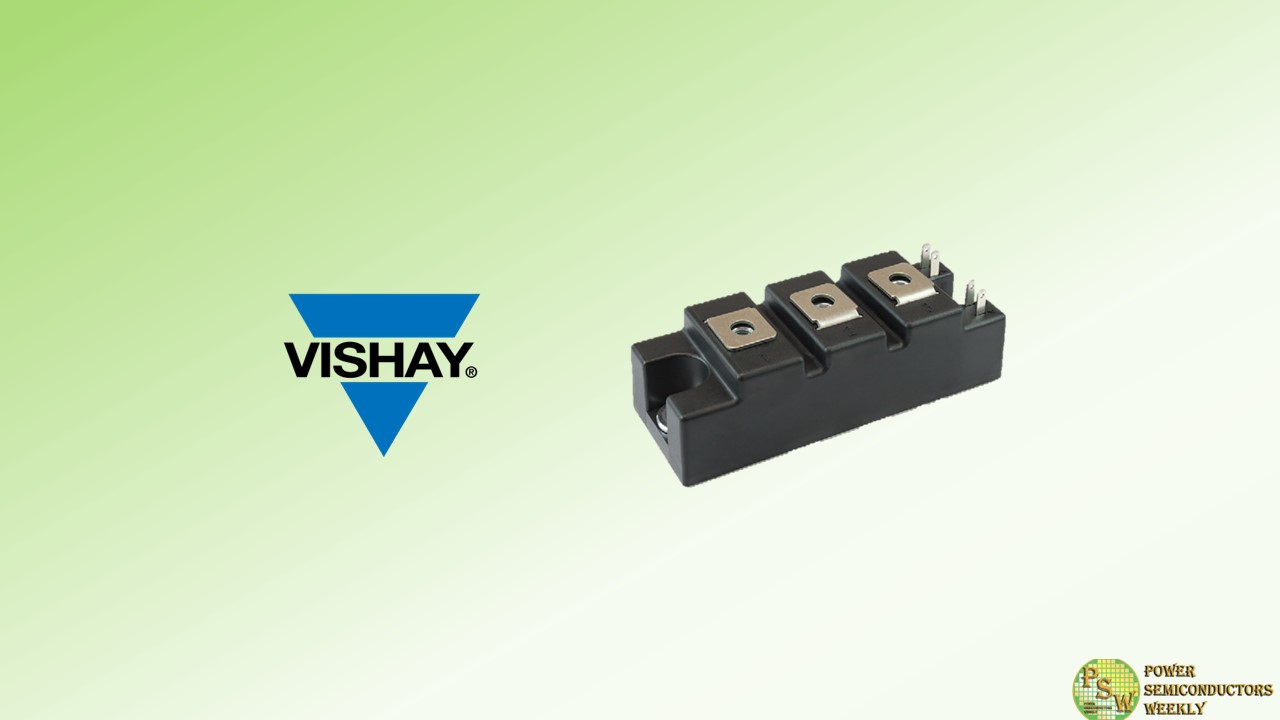
Vishay Intertechnology, Inc. introduced five new half-bridge IGBT power modules in the newly redesigned INT-A-PAK package. Built on Vishay’s Trench IGBT technology, the VS-GT100TS065S, VS-GT150TS065S, VS-GT200TS065S, VS-GT100TS065N, and VS-GT200TS065N offer designers a choice of two best in class technologies — low VCE(ON) or low Eoff — to lower conduction or switching losses in high current inverter stages for transportation, energy, and industrial applications.
The half-bridge devices released today combine Trench IGBTs — which deliver improved power savings versus other devices on the market — with Gen IV FRED Pt® anti-parallel diodes with ultra soft reverse recovery characteristics. Offering a new gate pin orientation, the modules’ compact INT-A-PAK package is now 100 % compatible with the 34 mm industry-standard package to offer a mechanical drop-in replacement.
The industrial-level devices will be used in power supply inverters for railway equipment; energy generation, distribution, and storage systems; welding equipment; motor drives; and robotics. To reduce conduction losses in output stages for TIG welding machines, the VS-GT100TS065S, VS-GT150TS065S, and VS-GT200TS065S offer an industry-low collector to emitter voltage of ≤ 1.07 V at +125 °C and rated current. For high frequency power applications, the VS-GT100TS065N and VS-GT200TS065N offer extremely low switching losses, with Eoff down to 1.0 mJ at +125 °C and rated current.
The RoHS-compliant modules feature 650 V collector to emitter voltages, continuous collector current from 100 A to 200 A, and very low junction to case thermal resistance. UL-approved file E78996, the devices can be directly mounted to heatsinks and offer low EMI to reduce snubbing requirements.
Device Specification Table:
Part # VCES IC VCE(ON) Eoff Speed Package @ IC and +125 °C VS-GT100TS065S 650 V 100 A 1.02 V 6.5 mJ DC to 1 kHz INT-A-PAK VS-GT150TS065S 650 V 150 A 1.05 V 10.3 mJ DC to 1 kHz INT-A-PAK VS-GT200TS065S 650 V 200 A 1.07 V 13.7 mJ DC to 1 kHz INT-A-PAK VS-GT100TS065N 650 V 100 A 2.12 V 1.0 mJ 8 kHz to 30 kHz INT-A-PAK VS-GT200TS065N 650 V 200 A 2.13 V 3.86 mJ 8 kHz to 30 kHz INT-A-PAK Original – Vishay Intertechnology


