-
 LATEST NEWS / PROJECTS / SiC / TOP STORIES / WBG
SiCrystal’s SiC Wafers Production Capacity to Triple by 2027 with a New Production Site in Nuremberg
July 4, 2024
2 Min ReadIn an important step towards strengthening the semiconductor industry and promoting sustainable technologies, SiCrystal GmbH will create new, additional production space in the north-east of Nuremberg, directly opposite the existing site. The new building will offer an additional 6,000 square meters of production space and will be equipped with state-of-the-art technology to further optimize the production of silicon carbide wafers.
The close proximity to the existing plant will ensure close integration of the production processes. SiCrystal’s total production capacity, including the existing building, will be approximately three times higher in 2027 than in 2024.
“The new space will significantly increase the production capacity for SiC substrates and we are proud that we were able to welcome Mayor König to the ground-breaking ceremony,” says Dr. Robert Eckstein, CEO of SiCrystal. This underlines the importance of this project for the city and the region.
“This groundbreaking ceremony marks an important milestone for SiCrystal and underlines our commitment to the metropolitan region. In this way, we can continue to supply innovative products of the highest quality for our customers in the future and make a positive contribution to global sustainability. “, said Dr. Erwin Schmitt, COO of SiCrystal. “With the additional production capacities, we will strengthen our market position and make an important contribution to technological development in the semiconductor industry.”
Nuremberg’s Mayor Marcus König congratulates on this event: “SiCrystal is one of the world’s leading manufacturers of silicon carbide semiconductor substrates – among other things, these products are needed for the energy transition. I am delighted that SiCrystal is committing itself to Nuremberg as a location with this massive investment and is thus not only retaining jobs but also creating new ones. Nuremberg is an attractive location.”
The construction work is scheduled to be completed by the beginning of 2026. And will create new jobs in the region. The new building is being realized in cooperation with the general contractor Systeambau from Hilpoltstein.
SiC wafers from SiCrystal, a subsidiary of the Japanese ROHM Group, are of crucial importance for the production of high-performance semiconductor components. By using SiC, we can achieve higher efficiency, lower energy consumption and improved performance in various applications such as electric vehicles, solar energy, and industrial equipment.
SiCrystal is proud to be a fast-growing employer in the metropolitan region and aims to increase employment by more than 100 by the end of the 2027/28 financial year.
Original – SiCrystal
-
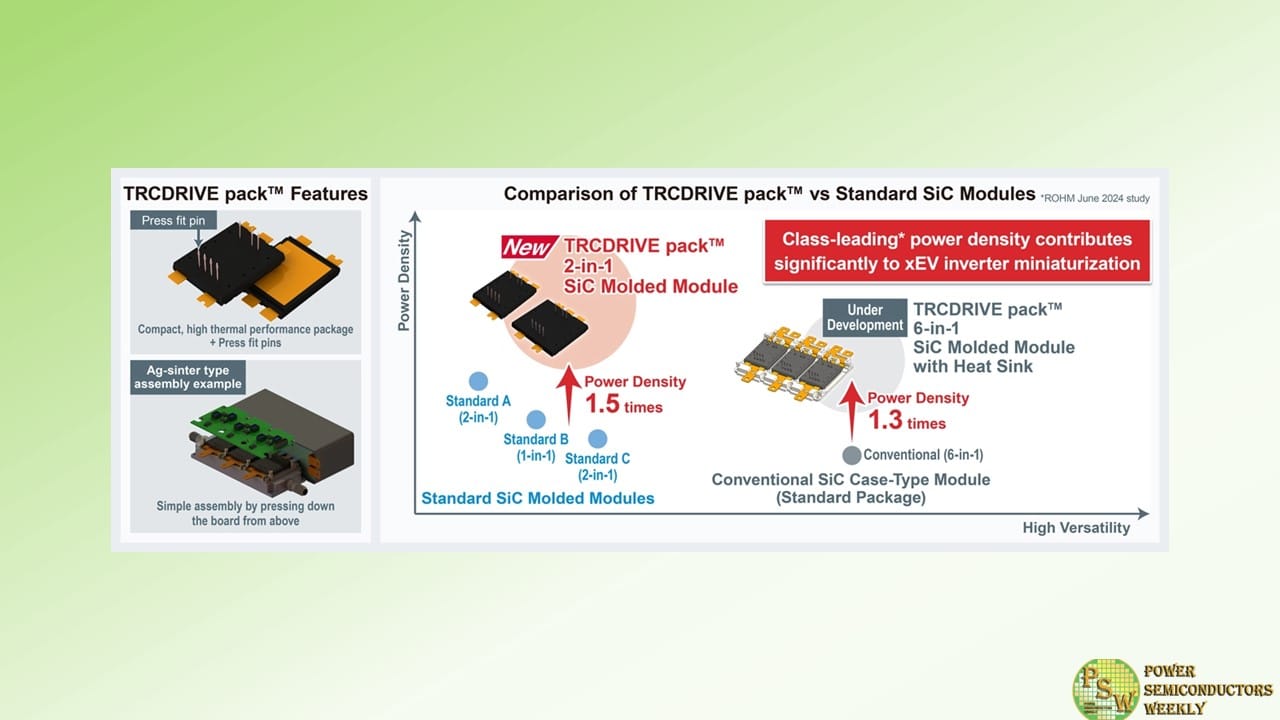
ROHM has developed four models as part of the TRCDRIVE pack™ series with 2-in-1 SiC molded modules (two of 750V-rated: BSTxxxD08P4A1x4, two of 1,200V-rated: BSTxxxD12P4A1x1) optimized for xEV (electric vehicles) traction inverters. TRCDRIVE pack™ supports up to 300kW and features high power density and a unique terminal configuration – help solving the key challenges of traction inverters in terms of miniaturization, higher efficiency, and fewer person-hours.
As the electrification of cars rapidly advances towards achieving a decarbonized society, the development of electric powertrain systems that are more efficient, compact, and lightweight is currently progressing. However, for SiC power devices that are attracting attention as key components, achieving low loss in a small size has been a difficult challenge. ROHM solves these issues inside powertrains with its TRCDRIVE pack™.
A trademark brand for ROHM SiC molded type modules developed specifically for traction inverter drive applications, TRCDRIVE pack™ reduces size by utilizing a unique structure that maximizes heat dissipation area. On top, ROHM’s 4th Generation SiC MOSFETs with low ON resistance are built in – resulting in an industry-leading power density 1.5 times higher than that of general SiC molded modules while greatly contributing to the miniaturization of inverters for xEVs.
The modules are also equipped with control signal terminals using press fit pins enabling easy connection by simply pushing the gate driver board from the top, reducing installation time considerably. In addition, low inductance (5.7nH) is achieved by maximizing the current path and utilizing a two-layer bus-bar structure for the main wiring, contributing to lower losses during switching.
TRCDRIVE pack™ is scheduled to be launched by March 2025 with a lineup of 12 models in different package sizes (Small / Large) and mounting patterns (TIM: heat dissipation sheet / Ag sinter). In addition, ROHM is developing a 6-in-1 product with built-in heat sink that is expected to facilitate rapid traction inverter design and model rollout tailored to a variety of design specifications.
Original – ROHM
-
ROHM and STMicroelectronics announced the expansion of the existing multi-year, long-term 150mm silicon carbide (SiC) substrate wafers supply agreement with SiCrystal, a ROHM group company. The new multi-year agreement governs the supply of larger volumes of SiC substrate wafers manufactured in Nuremberg, Germany, for a minimum expected value of $230 million.
Geoff West, EVP and Chief Procurement Officer, STMicroelectronics, commented “This expanded agreement with SiCrystal will bring additional volumes of 150mm SiC substrate wafers to support our devices manufacturing capacity ramp-up for automotive and industrial customers worldwide. It helps strengthen our supply chain resilience for future growth, with a balanced mix of in-house and commercial supply across regions”.
“SiCrystal is a group company of ROHM, a leading company of SiC, and has been manufacturing SiC substrate wafers for many years. We are very pleased to extend this supply agreement with our longstanding customer ST. We will continue to support our partner to expand SiC business by ramping up 150mm SiC substrate wafer quantities continuously and by always providing reliable quality”.said Dr. Robert Eckstein, President and CEO of SiCrystal, a ROHM group company.
Energy-efficient SiC power semiconductors enable electrification in the automotive and industrial sectors in a more sustainable way. By facilitating more efficient energy generation, distribution and storage, SiC supports the transition to cleaner mobility solutions, lower emissions industrial processes and a greener energy future, as well as more reliable power supplies for resource-intensive infrastructure like data centers dedicated to AI applications.
Original – STMicroelectronics
-
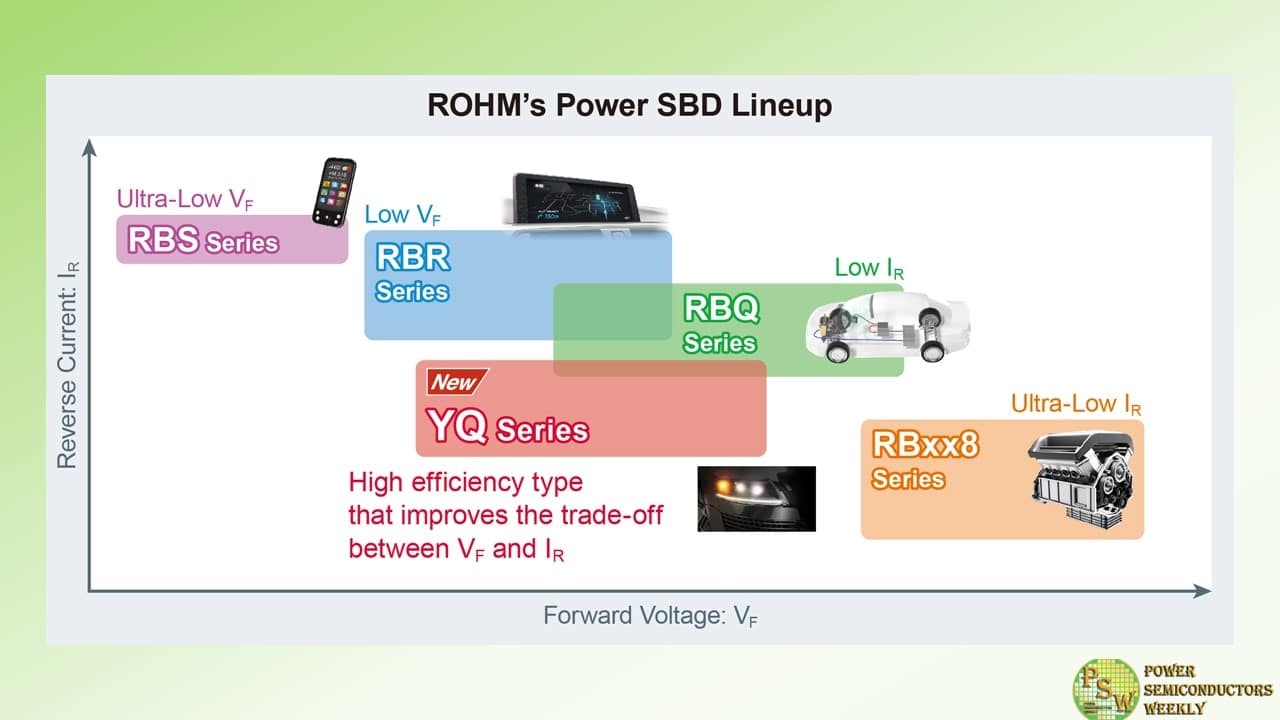
ROHM has developed 100V breakdown Schottky barrier diodes (SBDs) that deliver industry-leading reverse recovery time (trr) for power supply and protection circuits in automotive, industrial, and consumer applications.
Although numerous types of diodes exist, highly efficient SBDs are increasingly being used inside a variety of applications. Particularly SBDs with a trench MOS structure that provide lower VF than planar types enable higher efficiency in rectification applications. One drawback of trench MOS structures, however, is that they typically feature worse trr than planar topologies – resulting in higher power loss when used for switching.
In response, ROHM developed a new series utilizing a proprietary trench MOS structure that simultaneously reduces both VF and IR (which are in a trade-off relationship) while also achieving class leading trr.
Expanding on the four existing conventional SBD lineups optimized for a variety of requirements, the YQ series is ROHM’s first to adopt a trench MOS structure. The proprietary design achieves class-leading trr of 15ns that reduces trr loss by approx. 37% and overall switching loss by approx. 26% over general trench-type MOS products, contributing to lower application power consumption.
The new structure also improves both VF and IR loss compared to conventional planar type SBDs. This results in lower power loss when used in forward bias applications such as rectification, while also providing less risk of thermal runaway which is a major concern with SBDs. As such, they are ideal for sets requiring high-speed switching, such as drive circuits for automotive LED headlamps and DC-DC converters in xEVs that are prone to generate heat.
Going forward, ROHM will strive to further improve the quality of its semiconductor devices, from low to high voltages, while strengthening its expansive lineup to further reduce power consumption and achieve greater miniaturization.
SBD Trench MOS Structure
The trench MOS structure is created by forming a trench using polysilicon in the epitaxial wafer layer to mitigate electric field concentration. This reduces the resistance of the epitaxial wafer layer, achieving lower VF when applying voltage in the forward direction. At the same time, during reverse bias the electric field concentration is minimized, significantly decreasing IR. As a result, the YQ series improves VF and IR by approx. 7% and 82%, respectively, compared to conventional products.
And unlike with typical trench MOS structures where trr is worse than planar types due to larger parasitic capacitance (resistance component in the device), the YQ series achieves an industry-leading trr of 15ns by adopting a unique structural design. This allows switching losses to be reduced by approx. 26%, contributing to lower application power consumption.Application Examples
- Automotive LED headlamps
- xEV DC-DC converters
- Power supplies for industrial equipment
- Lighting
Original – ROHM
-
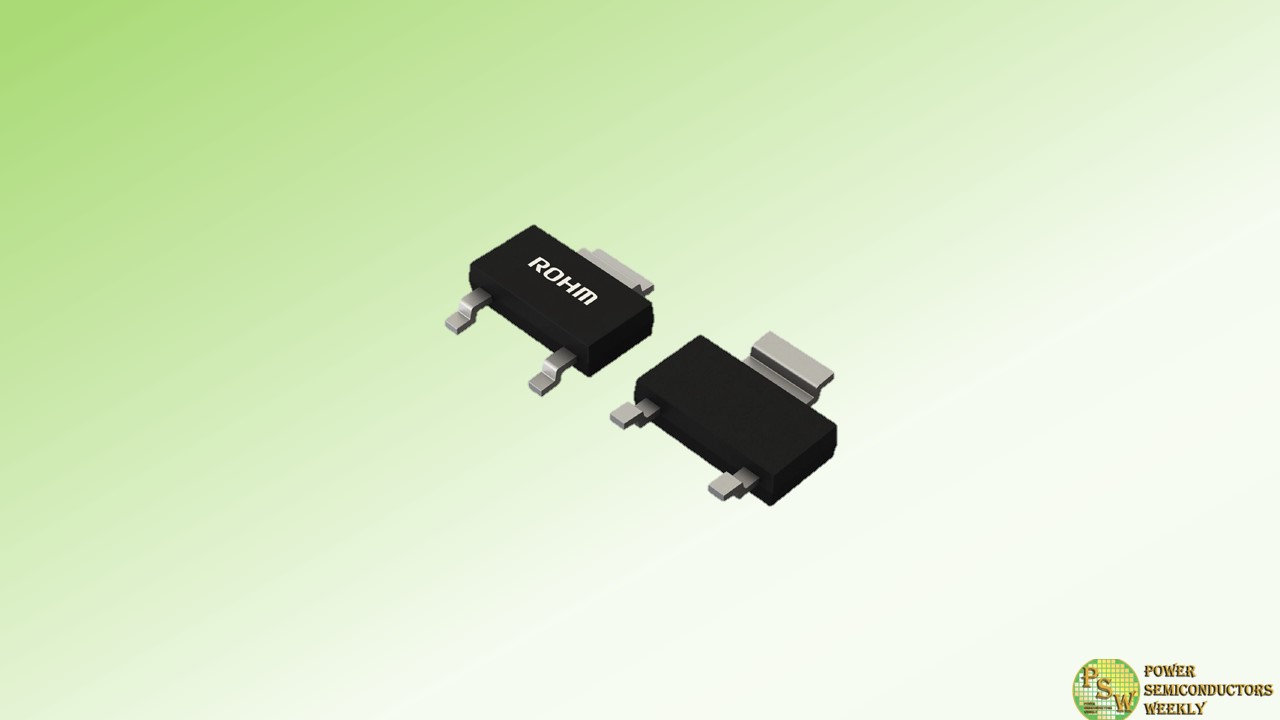
ROHM has added a lineup of compact 600V Super Junction MOSFETs R6004END4 / R6003KND4 / R6006KND4 / R6002JND4 / R6003JND4. These devices are ideal for small lighting power supplies, pumps, and motors.
In recent years, power supplies for lighting and motors for pumps are required to be smaller as devices become more sophisticated – spurring the demand for compact MOSFETs that are essential for switching operation.
Generally, however, it has been difficult to reduce the size of Super Junction MOSFETs while maintaining an optimal balance between high breakdown voltage and low ON resistance. In response, after reviewing the shape of the mounted chip, ROHM was able to develop 5 models in the SOT-223-3 package (6.50mm × 7.00mm × 1.66mm) – providing a smaller, lower profile form factor without compromising the performance of conventional products.
Compared to the conventional TO-252 package (6.60mm × 10.00mm × 2.30mm), ROHM’s new products reduce area and thickness by 31% and 27% – contributing to smaller, lower profile applications. At the same time, the same land pattern (footprint) as the TO-252 package can be used, enabling mounting on existing circuit boards without modification.
Offering distinctive features, three of the models optimized for compact power supplies. The R6004END4, characterized by low noise, is suitable for applications where noise is a concern, while the R6003KND4 and R6006KND4, capable of high-speed switching, are ideal for sets requiring low loss, high efficiency operation.
The R6002JND4 and R6003JND4 utilize proprietary PrestoMOS technology to achieve significantly lower switching losses by speeding up reverse recovery time (trr), making them well-suited for motors-equipped devices.
Supporting materials such as application notes, technical documents, and SPICE simulation models for each product are available on ROHM’s website free of charge to enable quick market introduction.
Going forward, ROHM will continue to expand its Super Junction MOSFET lineup in different packages and even lower ON resistances that contribute to solving social issues such as environmental protection by reducing power consumption in variety devices.
Product Lineup
For compact power supplies
Part No. Data
SheetPolarity
[ch]VDSS
[V]ID
[A]RDS(on) [Ω]
*VGS=10VQg [nC]
*VGS=10VPackage
[mm]Typ. Max. Typ. R6004END4 N 600 2.4 0.90 0.98 15 
SOT-223-3
(6.50×7.00×1.66)R6003KND4 1.3 1.30 1.50 8 R6006KND4 2.8 0.72 0.87 12 For motors
Part No. Data
SheetPolarity
[ch]VDSS
[V]ID
[A]RDS(on) [Ω]
*VGS=15VQg [nC]
*VGS=15Vtrr
[ns]Package
[mm]Typ. Max. Typ. Typ. R6002JND4 N 600 1.0 2.50 3.25 7 40
SOT-223-3
(6.50×7.00×1.66)R6003JND4 1.3 1.65 2.15 8 42 Application Examples
• R6004END4 / R6003KND4 / R6006KND4: Lighting, Air conditioners, Refrigerators, etc.
• R6002JND4 / R6003JND4: Motors for pumps, fans, copiers, etc.Original – ROHM
-

A plan by ROHM Co., Ltd. and Toshiba Electronic Devices & Storage Corporation to collaborate in the manufacture and increased volume production of power devices has been recognized and will be supported by the Ministry of Economy, Trade and Industry as a measure supporting the Japanese Government’s target of secure and stable semiconductor supply.
ROHM and Toshiba Electronic Devices & Storage will respectively make intensive investments in silicon carbide (SiC) and silicon (Si) power devices, effectively enhance their supply capabilities, and complementally utilize other party’s production capacity.
Power devices are essential components for supplying and managing power supply in all kinds of electronic equipment, and for achieving a carbon-free, carbon-neutral society. Current demand is expected to see continued growth.
In automotive applications, development of more efficient, smaller and lighter electric powertrains has advanced alongside the rapid expansion in vehicle electrification. In industrial applications, stable supply of power devices and improved characteristics are widely required to support increasing automation and higher efficiency requirements.
Against this backdrop, ROHM has formulated a management vision, “We focus on power and analog solutions and solve social problems by contributing to our customers’ needs for energy savings and miniaturization of their products.,” and accelerates its efforts for a carbon-free. SiC power devices are the keys to energy savings.
Since the world’s first mass production of SiC MOSFETs, ROHM has been constantly developing industry-leading technologies. Among these are ROHM’s latest 4th Generation SiC MOSFETs that will be adopted for numerous electric vehicles and industrial equipment. As one of its priority projects, ROHM is working on SiC business, which contains aggressive and continuous investment to increase the production capacity of SiC and meet strong demand growth.
Toshiba Group, with its long-standing Basic Commitment, “Committed to People, Committed to the Future.,” aims to advance the achievement of carbon neutrality and a circular economy. Toshiba Electronic Devices & Storage has for decades supplied Si power devices, mainly for automotive and industrial markets, that have helped to secure energy saving solutions and equipment miniaturization.
The company started production on a 300mm wafer line last year, and is accelerating investment to enhance production capacity and meet strong demand growth. It is also advancing development of a wider lineup of SiC power devices, especially for automotive and power transmission and distribution applications, taking full advantage of the expertise it has cultivated in railway vehicle applications.
ROHM has already announced its participation in the privatization of Toshiba, but this investment did not serve as the starting point for manufacturing collaboration between the two companies. Under intensifying international competition in the semiconductor industry, ROHM and Toshiba Electronic Devices & Storage have been considering collaboration in the power device business for some time, and that resulted in the joint application.
ROHM and Toshiba Electronic Devices & Storage will collaborate in manufacturing power devices, through intensive investments in SiC and Si power devices, respectively, toward enhancing both companies’ international competitiveness. The companies will also seek to contribute to strengthening the resilience of semiconductor supply chains in Japan.
Original – Toshiba
-
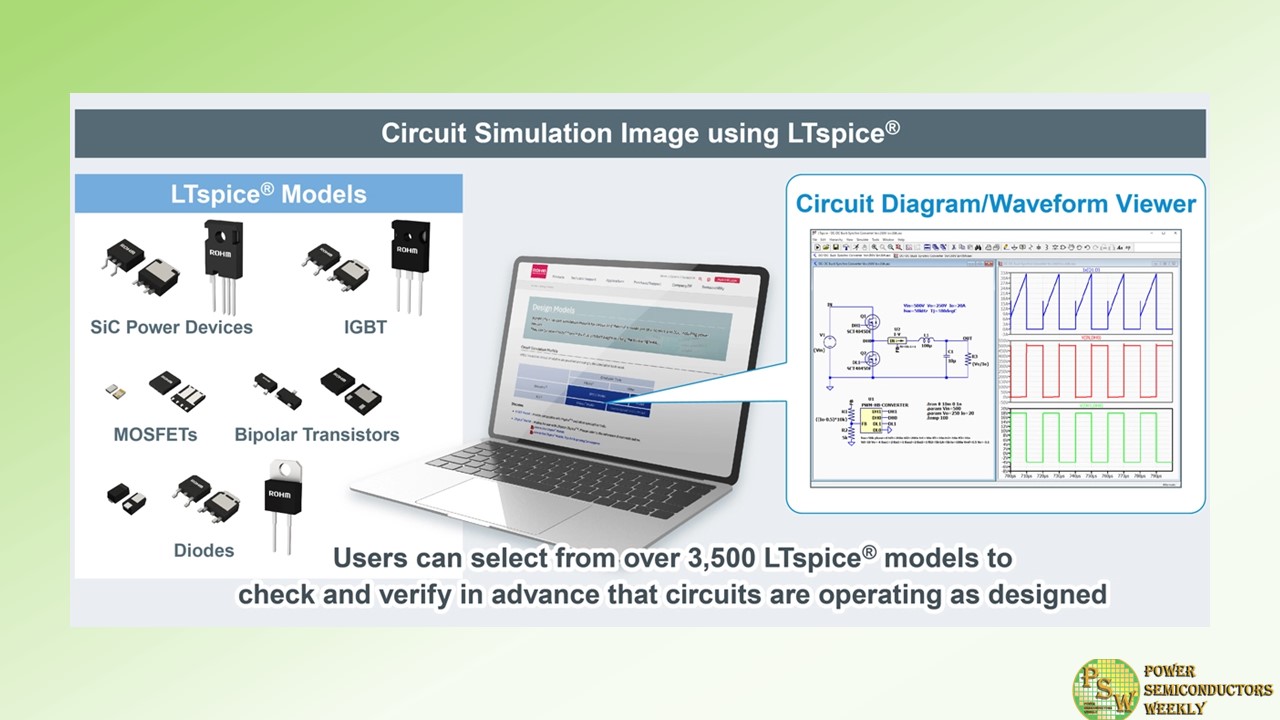
ROHM has expanded the library of SPICE model lineup for LTspice® of its circuit simulator. LTspice® is also equipped with circuit diagram capture and waveform viewer functions that make it possible for designers to check and verify in advance whether the circuit operation has been achieved as designed.
In addition to the existing lineup of bipolar transistors, diodes, and MOSFETs, ROHM has added SiC power devices and IGBTs that increases its number of LTspice® models to more than 3,500 for discretes (which can be downloaded from product pages). This brings the amount of coverage of LTspice® models on ROHM’s website to over 80% of all products – providing greater convenience to designers when using circuit simulators that incorporate discrete products, now including power devices.
In recent years, the increasing use of circuit simulation for circuit design has expanded the number of tools being utilized. Among these, LTspice® is an attractive option for a range of users, from students to even seasoned engineers at well-known companies. To support these and other users, ROHM has expanded its library of LTspice® models for discrete products.
Besides product pages, ROHM has added a Design Models page in October that allows simulation models to be downloaded directly. Documentation on how to add libraries and create symbols (schematic symbols) is also available to facilitate circuit design and simulation execution.
Going forward, ROHM will continue to contribute to solving circuit design issues by expanding the number of models compatible with various simulators while providing web tools such as ROHM Solution Simulator to meet growing customer needs.
Original – ROHM
-

ROHM has completed the acquisition of the assets of Solar Frontier’s former Kunitomi Plant located in Japan, on November 7, 2023, based on its basic agreement signed with Solar Frontier.
The Plant will be operated by LAPIS Semiconductor, a subsidiary of the ROHM Group, as its Miyazaki Plant No.2. It will become the Group’s main production site for SiC power devices and is aiming to start operation during 2024.
The ROHM Group will continue to strengthen its production capacity in accordance with its Medium-Term Management Plan while keeping abreast of market conditions, and will also thoroughly enhance its BCM system to ensure a stable supply of products to customers.
Original – ROHM
-
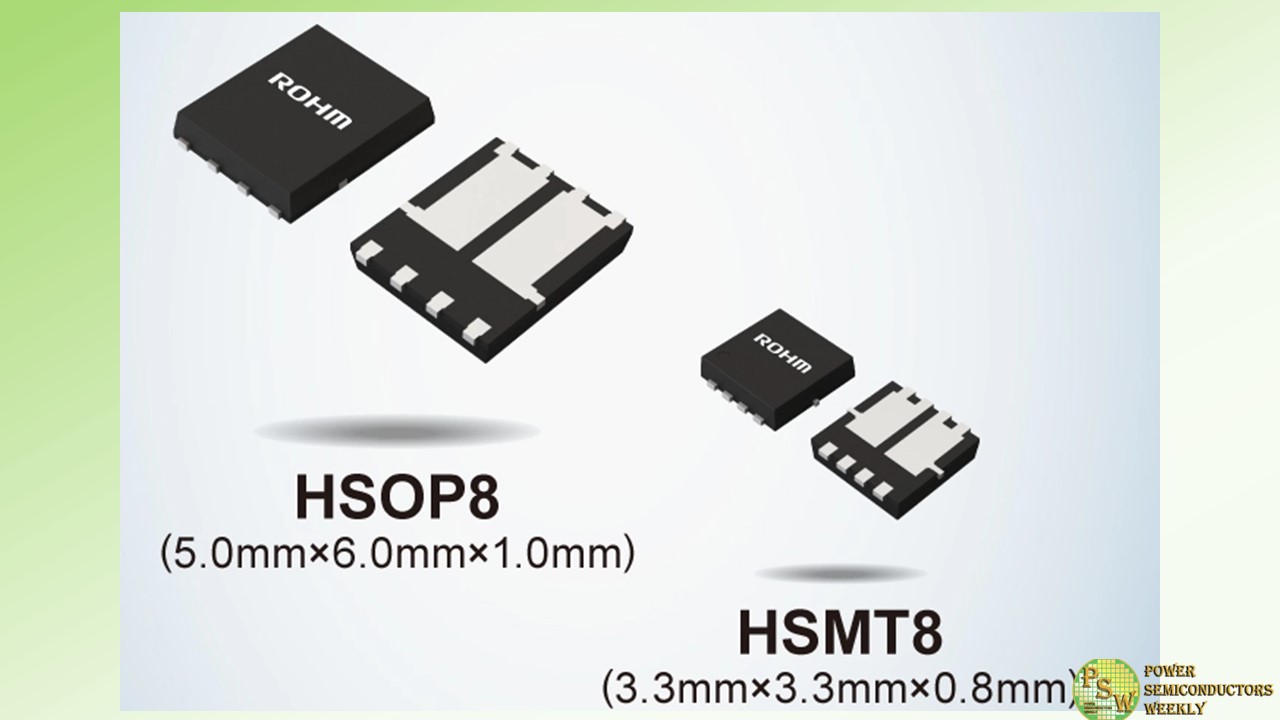
ROHM has developed dual MOSFETs that integrate two 100V chips in a single package – ideal for fan motor drive applied in communication base stations and industrial equipment. New five-models have been added as part of the HP8KEx/HT8KEx (Nch+Nch) and HP8MEx (Nch+Pch) series.
Recent years have seen a transition to higher voltages from conventional 12V/24V to 48V systems in communication base stations and industrial equipment, – intending to achieve higher efficiency by reducing current values. In these situations, switching MOSFETs are required a withstand voltage of 100V to account for voltage fluctuations, as 48V power supplies are also used in the fan motors for cooling these applications.
However, increasing the breakdown voltage raises ON resistance (RDS(on)) (which is in a trade-off relationship), leading to decreased efficiency, making it difficult to achieve both lower RDS(on) and higher breakdown voltage. Moreover, unlike multiple individual drive MOSFETs normally applied in fan motors - dual MOSFETs that integrate two chips in one package are increasingly being adopted to save space.
In response, ROHM developed two new series – the HP8KEx/HT8KEx (Nch+Nch) and the HP8MEx (Nch+Pch) – that combine Nch and Pch MOSFET chips using the latest processes. Both series achieve the industry’s lowest RDS(on) by adopting new backside heat dissipation packages with excellent heat dissipation characteristics. As a result, RDS(on) is reduced by up to 56% compared with standard dual MOSFETs (19.6mΩ for the HSOP8 and 57.0mΩ for the HSMT8 Nch+Nch), contributing to significantly lower set power consumption.
At the same time, combining two chips in a single package provides greater space savings by reducing area considerably. For example, replacing two single-chip TO-252 MOSFETs with one HSOP8 decreases footprint by 77%.
Next, ROHM will continue to expand its dual MOSFET lineup to withstand voltages ideal for industrial equipment while also developing low-noise variants. This is expected to contribute to solving social issues such as environmental protection by saving space and reducing power consumption in various applications.
Application Examples
– Fan motors for communication base stations
– Fan motors for factory automation, and other industrial equipment
– Fan motors for data center servers, etc.Original – ROHM
-

ROHM-Wako Electronics (Malaysia) Sdn. Bhd. (RWEM) in Malaysia held an opening ceremony for its newly building constructed to strengthen its analog IC production capacity and manufacturing subsidiary.
RWEM produces small-signal devices such as diodes and LEDs, and the new building will be used to produce isolated gate driver ICs, one of the focus products in analog ICs. Isolated gate driver ICs are ICs that optimally drive power semiconductors such as IGBTs and SiCs, and since they play an important role in energy saving and miniaturization of electric vehicles and industrial equipment, demand for these products is expected to grow.
RWEM will begin production of ICs for the first time in order to strengthen its production capacity and promote multi-location of analog IC production factories from the viewpoint of BCM (Business Continuity Management).
The new building will be equipped with a variety of energy-saving technologies to reduce environmental impact (expected to reduce CO2 emissions by about 15% compared to the current facilities). RWEM’s BCM system will be further strengthened by introducing various state-of-the-art disaster preventions. RWEM intends to bring in production machines and begin production in October, 2024. As a result, RWEM’s overall production capacity is expected to increase by approximately 1.5 times.
ROHM Group will continue to strengthen its production capacity in accordance with its Medium-Term Management Plan while keeping abreast of market conditions, and will also thoroughly enhance its BCM system to ensure a stable supply of products to customers.
Original – ROHM

