-
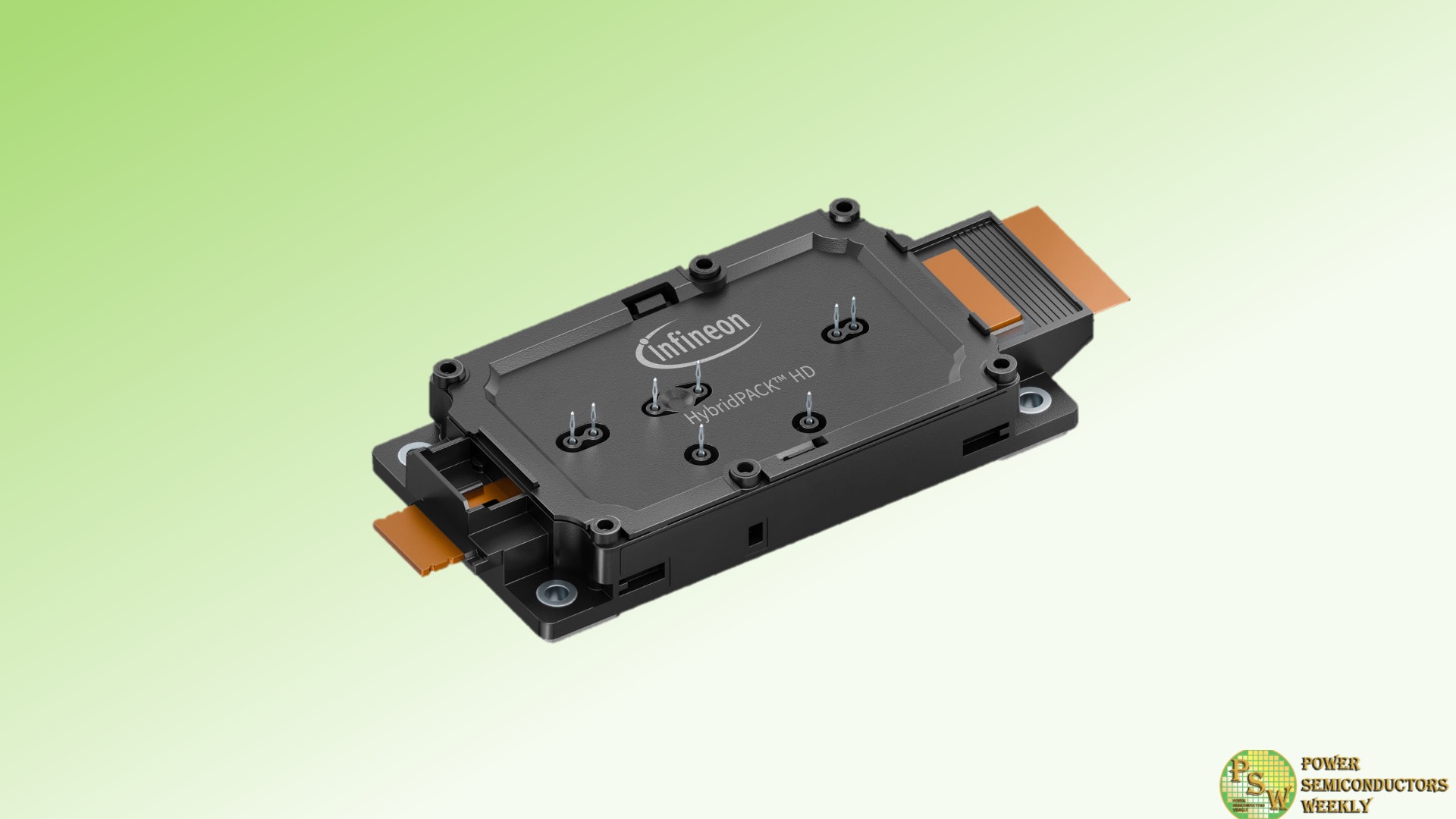
Infineon Technologies has introduced HybridPACK HD, a new silicon carbide (SiC) power module designed specifically for drivetrain inverters in heavy-duty electric commercial vehicles. Featuring the company’s 1,400 V CoolSiC MOSFET technology, the module delivers output RMS currents ranging from 500 A to 1,200 A and is engineered to meet the demanding reliability and lifetime requirements of electric trucks, buses and coaches.
The new HybridPACK HD extends Infineon’s established HybridPACK automotive power module portfolio into the commercial vehicle market, where electric drivetrains must withstand considerably longer operating periods, higher electrical loads and more demanding environmental conditions. The module is designed to support vehicle lifetimes exceeding 1.2 million kilometers, addressing the durability requirements of applications ranging from long-haul freight transportation to urban delivery fleets and public transportation.
Electrification of commercial vehicles is creating new requirements for power semiconductor technologies as manufacturers seek to improve energy efficiency, reliability and vehicle operating economics. Unlike passenger cars, heavy-duty trucks and buses frequently operate under sustained high loads, experience repeated acceleration and braking cycles, and must remain in service for extended periods. These conditions place significant stress on traction inverters and their semiconductor components, making thermal performance, mechanical durability and long-term reliability essential design considerations.
Infineon’s HybridPACK HD has been developed to address these requirements through a combination of high-voltage SiC MOSFET technology, advanced semiconductor interconnections and a power module architecture optimized for high-current operation. The module is intended for electric commercial vehicle drivetrains that must operate reliably under intense power cycling, severe vibration and operating lifetimes exceeding 80,000 hours.
At the center of the new module are Infineon’s 1,400 V CoolSiC MOSFETs, which provide the high-voltage switching capability required for next-generation commercial vehicle traction systems. Silicon carbide technology offers advantages over conventional silicon power devices in high-voltage applications, including lower switching losses and the ability to operate efficiently at demanding power levels. These characteristics can help manufacturers develop more compact traction inverters while improving energy conversion efficiency and reducing thermal management requirements.
The HybridPACK HD delivers an output RMS current of 500 A to as much as 1,200 A, enabling high-power drivetrain inverter designs without the need to connect multiple power modules in parallel. This capability is particularly relevant for heavy-duty commercial vehicles, where propulsion systems must deliver substantial torque and power over extended operating periods. Eliminating the need for parallel modules can simplify inverter architecture, reduce the number of electrical and mechanical connections, and support more compact system designs.
The module incorporates Infineon’s .XT interconnection technology, which is designed to improve the reliability and durability of power semiconductor assemblies under demanding thermal and electrical conditions. In traction inverter applications, repeated heating and cooling cycles can place considerable mechanical stress on semiconductor interconnections and packaging materials. Advanced interconnection technologies help address these challenges by improving the ability of the power module to withstand long-term power cycling.
Reliability is particularly important in commercial vehicle applications because inverter failures can result in costly vehicle downtime and operational disruption. For fleet operators, the durability of power electronics contributes directly to maintenance requirements, vehicle availability and total cost of ownership. By designing HybridPACK HD for extended service life and demanding operating conditions, Infineon is targeting one of the central challenges associated with the electrification of heavy-duty transportation.
Thermal management is another important element of the module’s design. HybridPACK HD features an architecture optimized for SiC performance, combining low electrical inductance with efficient heat dissipation to support high-current switching. Low-inductance power module designs are valuable in SiC-based inverters because the fast switching characteristics of silicon carbide devices can generate voltage overshoots and electrical stresses if parasitic inductance is not adequately controlled.
The module also supports direct liquid cooling, enabling heat to be removed efficiently from the power semiconductor assembly. This cooling capability is especially relevant for heavy-duty electric drivetrains, where sustained high-power operation can generate substantial thermal loads. Effective cooling helps maintain semiconductor operating temperatures within the required limits while supporting higher inverter power density and long-term reliability.
A significant feature of HybridPACK HD is its support for battery voltages of up to 1,500 V DC. Higher-voltage battery architectures are becoming increasingly relevant for heavy-duty electric vehicles because they can reduce the current required to deliver a given amount of electrical power. Lower current can help limit resistive losses in cables and other electrical components, while supporting more efficient power distribution across high-power vehicle platforms.
The 1,500 V DC capability also positions HybridPACK HD for future commercial vehicle architectures designed around megawatt-class charging. Heavy-duty electric trucks and buses require charging solutions capable of replenishing large battery packs within operationally practical timeframes, particularly in long-distance transport and high-utilization fleet applications. Supporting higher battery voltages can help enable faster charging at elevated power levels without requiring a proportional increase in charging current.
According to Infineon, the module’s voltage capability allows manufacturers to prepare vehicle platforms for future megawatt charging requirements without redesigning the inverter power module. This provides greater flexibility as commercial vehicle battery systems and charging infrastructure evolve toward higher-voltage operation.
The combination of high current capability, extended lifetime design and support for high-voltage battery architectures makes HybridPACK HD particularly relevant for electric trucks operating on long-distance routes. These vehicles require propulsion systems capable of maintaining high efficiency under sustained loads while meeting demanding durability targets over hundreds of thousands of kilometers.
Urban electric buses and coaches represent another important application area. Public transportation vehicles frequently operate through repeated acceleration and braking cycles, exposing their traction inverters to recurring electrical and thermal stresses. Reliable SiC power modules can help manufacturers address these operating conditions while improving drivetrain efficiency and supporting compact vehicle power electronics.
For commercial vehicle manufacturers, integrating high-performance SiC power modules into traction inverter designs can also help reduce system complexity. The ability to achieve high output currents with a single module, combined with integrated thermal management capabilities, offers opportunities to simplify inverter assembly and optimize packaging within increasingly complex electric vehicle platforms.
The introduction of HybridPACK HD reflects the growing importance of silicon carbide power semiconductors in commercial vehicle electrification. While SiC technology has already gained significant traction in passenger electric vehicles, heavy-duty applications introduce additional requirements related to current handling, mechanical robustness, operating lifetime and compatibility with high-voltage battery systems.
By extending its HybridPACK portfolio into this segment, Infineon is addressing the specific needs of electric commercial vehicle manufacturers with a power module designed around high-current operation, advanced cooling and long-term reliability. The use of 1,400 V CoolSiC MOSFETs and .XT interconnection technology brings together semiconductor performance and packaging durability in a solution intended for demanding drivetrain environments.
HybridPACK HD also illustrates how power module development is evolving alongside changes in electric vehicle electrical architectures. As manufacturers move toward higher battery voltages and megawatt-class charging, traction inverter components must accommodate greater power levels while maintaining efficiency, reliability and manageable system costs.
With output RMS currents of up to 1,200 A, support for battery voltages up to 1,500 V DC and a design lifetime exceeding 1.2 million kilometers, Infineon’s HybridPACK HD provides a new SiC-based power module platform for heavy-duty electric transportation. The introduction strengthens the company’s position in automotive power semiconductors while supporting the development of more efficient and durable electric drivetrains for commercial vehicles.
Original – Infineon Technologies
-
Infineon Technologies is expanding its collaboration with Shenzhen Megmeet Electrical to develop high-efficiency power solutions for next-generation AI data centers, with a particular focus on 800 VDC power distribution architectures. As part of the partnership, Megmeet is integrating Infineon’s second-generation CoolSiC silicon carbide MOSFETs into a three-phase AI power shelf designed to improve energy efficiency, power density and reliability in increasingly demanding server environments.
The collaboration extends beyond the three-phase power shelf to several critical components of data center power infrastructure, including server power supply units (PSUs), intermediate bus converters (IBCs) and solid-state transformers (SSTs). By combining Infineon’s power semiconductor technologies with Megmeet’s expertise in digital power conversion, the companies aim to support the transition toward more efficient and scalable electrical architectures for AI computing facilities.
The announcement comes as the rapid deployment of AI accelerators and high-performance computing systems places growing demands on data center power infrastructure. Higher server power requirements, changing load profiles and increasing rack-level power densities are creating new challenges for conventional power distribution systems. These developments are encouraging the industry to explore higher-voltage DC architectures capable of delivering large amounts of electrical power while limiting distribution losses and improving overall system efficiency.
An 800 VDC architecture can offer advantages in high-power data center environments by reducing the current required to deliver a given amount of power. Lower current can help reduce resistive losses in electrical distribution systems and support more compact power delivery infrastructure. However, realizing these benefits requires efficient and reliable power conversion equipment, particularly at the interfaces between incoming electrical supplies, high-voltage DC distribution and the lower-voltage power rails used by computing hardware.
Infineon’s CoolSiC MOSFET G2 technology is central to Megmeet’s new three-phase power shelf. Silicon carbide MOSFETs offer switching and conduction characteristics that make them well suited to high-voltage, high-efficiency power conversion. By reducing losses within the switching devices, the technology can improve conversion efficiency and reduce the amount of heat generated during operation, supporting higher power density and more effective thermal management.
According to Megmeet, the three-phase AI power shelf developed using Infineon’s CoolSiC G2 devices achieves system efficiency well above the peak-efficiency requirements of the 80 PLUS Ruby certification level. The result highlights the potential of advanced SiC power semiconductors to improve the performance of high-power server supply systems, where even relatively small efficiency gains can translate into meaningful reductions in electricity consumption and cooling requirements across large installations.
The CoolSiC G2 devices also incorporate Infineon’s .XT interconnection technology, which is designed to reduce thermal resistance and improve heat dissipation within the semiconductor package. Effective thermal management is particularly important in high-density data center power supplies, where components operate under substantial electrical loads and must maintain stable performance over extended periods.
By improving heat transfer from the semiconductor devices, the .XT technology contributes to the thermal performance and long-term reliability of the power conversion system. This is especially relevant for AI infrastructure, where high utilization rates and demanding operating conditions place considerable stress on power electronics.
Another important requirement for AI server power systems is the ability to respond to rapidly changing electrical loads. AI computing workloads can create significant variations in power demand, requiring power conversion equipment to maintain stable output while responding quickly to changing operating conditions. Infineon and Megmeet are positioning the CoolSiC G2-based power shelf to support more stable power delivery under these dynamic load conditions.
Peter Wawer, Chief Technology Officer of Infineon’s Power Systems Division, emphasized the growing importance of efficient and adaptable power infrastructure as AI reshapes global data center requirements. He described the collaboration as an opportunity to combine advanced power semiconductor products with system-level innovation across power supply units, intermediate bus converters and solid-state transformers.
For Infineon, the partnership also reflects the expanding role of silicon carbide beyond its established applications in electric vehicles, renewable energy and industrial power conversion. The growing electrical demands of AI data centers are creating additional opportunities for high-performance power semiconductors, particularly in applications where high voltage, efficiency and power density are critical design considerations.
Megmeet brings experience in digital power conversion and server power supply development to the collaboration. The company’s three-phase power shelf represents a further step in its efforts to address the changing requirements of AI computing infrastructure, where power supply performance must keep pace with rising server and rack-level power demands.
William Zhang, Corporate Executive Vice President and General Manager of Megmeet’s Power Solution Business Group, highlighted efficiency, reliability and scalability as increasingly important requirements for AI server customers. He said the combination of Infineon’s SiC technology and Megmeet’s digital power expertise had enabled the development of a three-phase power shelf with efficiency exceeding the 80 PLUS Ruby peak-efficiency requirements.
The latest development builds on an established relationship between the two companies. Megmeet previously adopted Infineon’s CoolMOS 8 superjunction MOSFETs and OptiMOS 6 MOSFETs in its single-phase AI server power supply platforms. Those designs combined advanced silicon power semiconductor technologies with Megmeet’s power conversion expertise to address efficiency, power density and reliability requirements.
The expanded collaboration illustrates how different power semiconductor technologies can serve complementary roles within data center electrical infrastructure. Silicon carbide MOSFETs are particularly relevant to high-voltage conversion stages, while silicon superjunction and low-voltage MOSFET technologies remain important in other parts of server power systems. Selecting suitable devices for each conversion stage is essential to optimizing overall efficiency, thermal performance and system cost.
Intermediate bus converters and solid-state transformers are expected to become increasingly important as data center power architectures evolve. IBCs provide conversion between distribution voltages and intermediate power rails, while SSTs use power electronic conversion to perform functions traditionally associated with conventional transformers, potentially offering additional flexibility in electrical power management and distribution.
By extending their cooperation across these technologies, Infineon and Megmeet are addressing a broader portion of the power conversion chain rather than focusing solely on individual server power supplies. This system-level approach is particularly relevant to 800 VDC architectures, where the efficiency and reliability of each conversion stage contribute to the performance of the overall electrical infrastructure.
The partnership also reflects a broader shift in the power semiconductor market as AI infrastructure becomes an increasingly important source of demand for advanced power devices. Higher data center power densities are encouraging manufacturers to develop solutions that combine lower semiconductor losses, improved thermal characteristics and greater integration at the power system level.
Looking ahead, Infineon and Megmeet plan to deepen their cooperation in AI data center power systems, 800 VDC distribution and next-generation power infrastructure. Their work will span technologies ranging from server PSUs to solid-state transformers, with the aim of improving efficiency and scalability across the data center power delivery chain.
The adoption of CoolSiC G2 MOSFETs in Megmeet’s three-phase AI power shelf demonstrates the growing relevance of silicon carbide technology in high-performance computing infrastructure. As AI data centers move toward higher-voltage power distribution and increasingly demanding operating conditions, advanced SiC and silicon MOSFET technologies are set to play a central role in enabling more efficient, reliable and scalable power conversion systems.
Original – Infineon Technologies


