-
STMicroelectronics has announced an investment of more than €100 million to expand and modernize its semiconductor manufacturing facility in Rousset, southern France. The investment program, which began in 2025 and will continue through 2027, includes an expansion of the site’s 200 mm wafer fabrication clean room, increased factory automation and improvements to production processes aimed at strengthening manufacturing efficiency, capacity and supply continuity.
The investment forms part of STMicroelectronics’ broader industrial footprint restructuring strategy and reinforces the company’s commitment to semiconductor manufacturing in Europe. The Rousset facility is an important production and technology center serving automotive, industrial, consumer electronics and space applications, combining semiconductor design, research and development, silicon wafer fabrication, electrical testing and commercial activities within a single industrial site.
Located in the Bouches-du-Rhône department of France, the Rousset facility employs approximately 3,000 people and operates continuously, 24 hours a day, seven days a week. Its semiconductor products are used in a wide range of applications, including smartphones, data centers, automobiles, banking and payment systems, electronic passports and satellite communications. The new investment is intended to support growing customer demand while improving the site’s competitiveness through higher productivity, advanced manufacturing technologies and more efficient production flows.
A central element of the program is the expansion of the existing 200 mm semiconductor clean room by 1,000 square meters, increasing its total area from 10,000 to 11,000 square meters. The additional space will accommodate new manufacturing equipment and upgrades to existing production systems, enabling ST to increase wafer processing capabilities and support higher production volumes.
The clean room expansion represents a 10% increase in manufacturing floor space and is designed to improve the site’s ability to respond to changing semiconductor demand. Rather than focusing exclusively on additional equipment, ST is combining the physical expansion with improvements in factory organization, equipment utilization and process integration. This approach is intended to increase manufacturing productivity while maintaining the quality and reliability standards required by automotive, industrial and other demanding semiconductor markets.
Alongside the clean room expansion, STMicroelectronics is significantly extending its automated wafer transport infrastructure. The facility’s Automated Material Handling System (AMHS), which moves wafer lots between manufacturing equipment and processing areas, will receive an additional 700 meters of overhead transport rails. This will increase the system’s total length from 900 meters to approximately 1,600 meters.
The expanded transport network will allow wafer lots to travel up to 30 kilometers per day within the production environment, supporting more efficient movement of materials between manufacturing steps. By reducing manual handling and improving the coordination of wafer movements, the automated system is expected to enhance production safety, process consistency and operational responsiveness.
ST is also introducing more advanced production control systems and connected process monitoring technologies. These improvements are intended to provide greater visibility into manufacturing operations, allowing production teams to optimize equipment scheduling, monitor process performance and respond more effectively to changes in factory conditions. The integration of automation, digital monitoring and artificial intelligence is a key part of the company’s strategy to improve manufacturing efficiency and strengthen cost competitiveness.
Thomas Morgenstern, Executive Vice President of Manufacturing at STMicroelectronics, emphasized the strategic importance of the Rousset facility for the company’s automotive, industrial, space and consumer electronics businesses. He highlighted productivity, quality, supply continuity and cost control as critical factors in semiconductor manufacturing, describing the investment as an example of ST’s approach to combining European industrial capacity with AI, automation and workforce development.
The modernization program also reflects the continued relevance of 200 mm silicon wafer manufacturing within the global semiconductor industry. While advanced logic and memory production increasingly relies on larger wafer formats, 200 mm manufacturing remains important for a broad range of established semiconductor technologies and applications. Improving automation and equipment utilization at existing facilities can provide manufacturers with opportunities to increase output and reduce operating costs without relying exclusively on new factory construction.
For STMicroelectronics, the Rousset investment supports a manufacturing strategy that combines established silicon semiconductor production with more advanced digital factory technologies. The expansion is intended to strengthen the site’s ability to serve customers across multiple markets while improving the predictability and flexibility of its manufacturing operations.
The investment is also creating employment opportunities and supporting the development of specialized semiconductor manufacturing skills. According to ST, the program has already resulted in the creation of 100 positions, filled through external recruitment and internal mobility. Approximately 40 additional engineering and technician positions remain open as the company continues implementing the expansion.
Workforce development is an important part of the project, with ST providing employees opportunities to develop expertise in automation, digitalization, process control and equipment supervision. As semiconductor factories become increasingly automated and data-driven, these capabilities are becoming more important for maintaining manufacturing efficiency, supporting complex production processes and improving equipment performance.
Philippe Marc, Director of STMicroelectronics’ Rousset site, described the investment as a new stage in the facility’s development. He emphasized that the clean room expansion and manufacturing upgrades will strengthen production capabilities while creating opportunities for employees to develop new technical skills and advance their careers.
The project also involves approximately 60 partner companies, demonstrating the importance of the Rousset facility within the industrial ecosystem of the Provence-Alpes-Côte d’Azur region. These companies are contributing to the implementation of the manufacturing expansion and modernization program, supporting local industrial activity and the development of semiconductor-related expertise.
The Rousset investment forms part of STMicroelectronics’ wider manufacturing and research presence in France, where the company has operated for more than five decades. Between 2018 and 2026, ST expects to have invested a combined €12.1 billion, equivalent to approximately $13.5 billion, in capital expenditure and research and development activities across its French operations.
STMicroelectronics currently operates 12 sites in France, including four manufacturing facilities, and employs approximately 12,500 people in the country. More than 3,000 of these employees are researchers and engineers dedicated to research and development, reflecting the company’s substantial semiconductor technology and engineering activities.
The company also collaborates with nearly 150 industrial and scientific partners in France, with small and medium-sized enterprises accounting for approximately 42% of these partnerships. These relationships support semiconductor research, industrial innovation and the development of local supply chains, contributing to efforts to strengthen French and European technological capabilities.
The investment comes as semiconductor manufacturers continue to evaluate how existing production facilities can be modernized to improve productivity, flexibility and competitiveness. Factory automation, advanced process monitoring and optimized material handling are becoming increasingly important tools for increasing manufacturing efficiency, particularly at established wafer fabrication sites.
By expanding its Rousset clean room and upgrading the site’s manufacturing infrastructure, STMicroelectronics is reinforcing its European production capabilities while pursuing improvements in cost efficiency and operational resilience. The €100 million-plus program will increase the capacity of an established 200 mm semiconductor manufacturing facility and support the company’s long-term ability to supply components for automotive, industrial, space and consumer electronics applications.
The project illustrates STMicroelectronics’ strategy of strengthening existing European semiconductor manufacturing assets through a combination of targeted capacity expansion, automation and workforce development, positioning the Rousset site for continued operation as an advanced semiconductor production center beyond 2027.
Original – STMicroelectronics
-
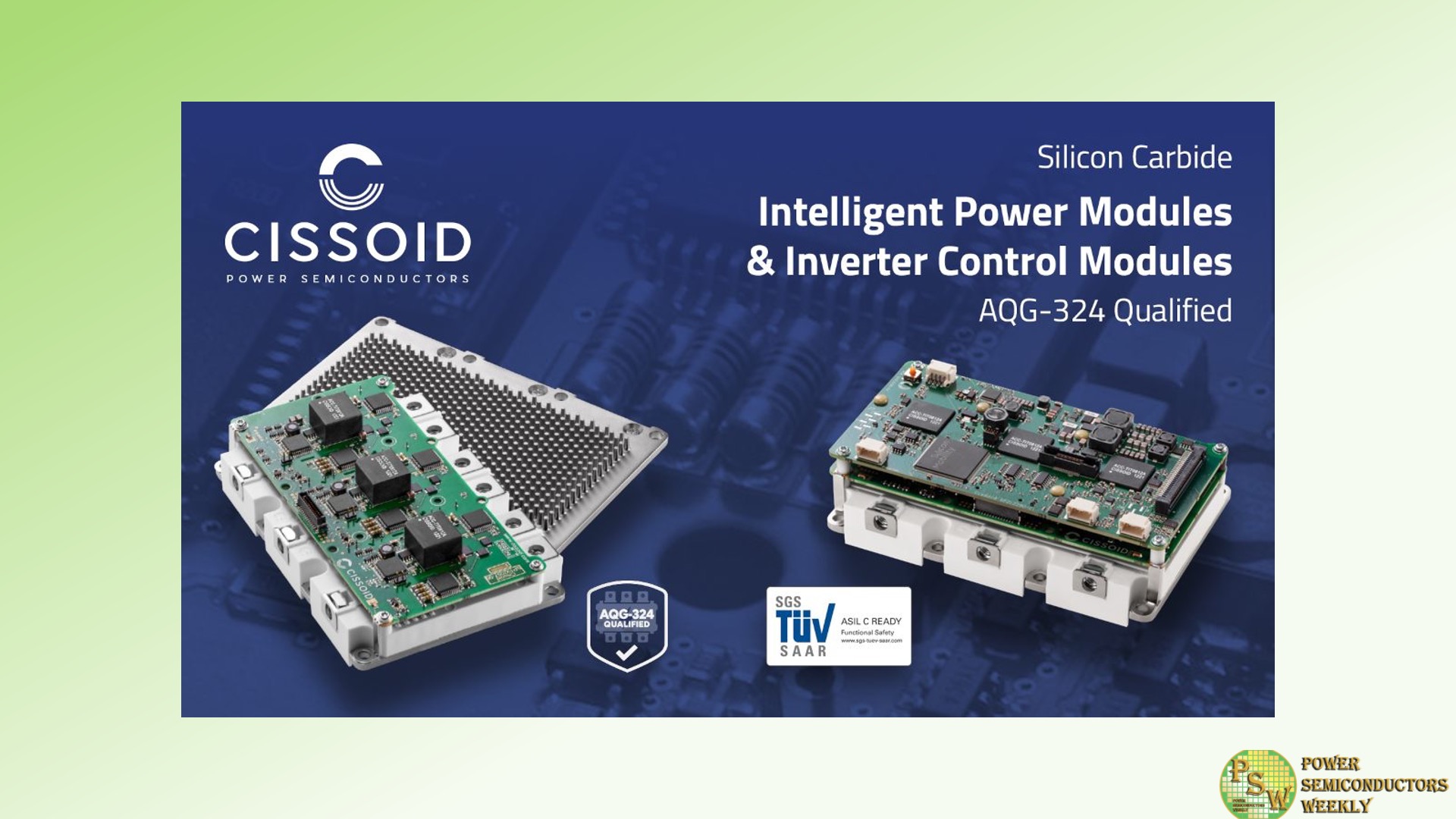
CISSOID has achieved AQG-324 automotive qualification for its silicon carbide (SiC) Intelligent Power Modules (IPMs) and Inverter Control Modules (ICMs), extending reliability validation to complete integrated power electronics assemblies. The qualification covers not only the SiC power semiconductor modules but also their associated gate driver electronics and motor control boards, providing automotive manufacturers with validated solutions for developing compact, efficient and reliable electric drive systems.
The achievement marks an important step in the qualification of integrated SiC power electronics for automotive applications. Traditionally, AQG-324 qualification has focused on power semiconductor modules, evaluating their ability to withstand demanding electrical, thermal and mechanical conditions throughout their operating life. CISSOID has expanded this approach to encompass the complete functional assemblies used in automotive inverters, addressing reliability at the level at which these systems are integrated into electric vehicles.
CISSOID’s Intelligent Power Modules combine a SiC power module with its associated gate driver board, while the company’s Inverter Control Modules integrate the power module, gate driver board and motor control board. By extending AQG-324 qualification to these configurations, CISSOID ensures that the electronic boards and their interconnections are included in the reliability assessment alongside the semiconductor power stage. This approach supports the development of integrated inverter solutions in which the performance and durability of individual components must be matched by the reliability of the complete assembly.
A notable feature of the qualified IPMs is their ability to operate at ambient temperatures of up to +125°C. This high-temperature capability is particularly relevant for electric vehicle power electronics, where compact packaging, elevated power density and demanding thermal environments place considerable requirements on semiconductor devices and supporting electronics. The combination of SiC technology and integrated gate driving is intended to help designers develop efficient inverter systems while simplifying thermal management and reducing system complexity.
The AQG-324 qualification process includes a comprehensive range of environmental and electrical reliability tests. Thermal shock testing exposes the modules to repeated transitions between low and high temperatures, assessing their resistance to thermomechanical stresses that can develop within semiconductor packages, substrates, electronic boards and interconnections. These conditions are representative of the temperature variations experienced by automotive power electronics during vehicle operation and across different environmental conditions.
Power cycling tests evaluate the durability of the modules under repeated electrical loading and the resulting heating and cooling cycles. These tests are particularly important for SiC inverter applications, where changes in operating current and switching conditions create recurring thermal stresses within the power stage. The ability of internal connections and packaging structures to withstand these cycles is a key factor in maintaining reliable performance over the operating life of an electric drive system.
Mechanical reliability is addressed through vibration and shock testing, which assess the ability of the integrated assemblies to withstand the physical stresses encountered in automotive environments. By including the gate driver and motor control boards within the qualification scope, CISSOID extends this assessment to the connections and supporting electronics that form part of the complete inverter architecture. This is especially relevant for highly integrated power electronics, where mechanical and electrical interfaces between components can influence overall system reliability.
The qualification also incorporates high-temperature electrical stress testing, including reverse-bias and gate-bias tests designed to evaluate stability under sustained temperature and voltage conditions. Combined humidity, temperature and voltage testing further assesses resistance to moisture-related degradation under electrical bias. Together, these tests address several important mechanisms that can affect the long-term performance of power semiconductor assemblies in demanding automotive applications.
For electric vehicle manufacturers and inverter developers, the qualification of complete integrated assemblies offers advantages in system design and validation. Rather than separately integrating and qualifying individual power modules, gate drivers and control boards, engineers can work with a pre-integrated platform whose principal electronic and mechanical interfaces have been evaluated together. This can simplify development, reduce integration effort and help accelerate the transition from inverter design to automotive system validation.
The announcement also reflects the growing role of integration in SiC-based automotive power electronics. Silicon carbide devices enable efficient power conversion and support compact, high-power-density inverter architectures, but achieving reliable operation requires close coordination between the semiconductor power stage, gate driving circuitry, control electronics and thermal design. CISSOID’s approach brings these elements together within qualified assemblies, helping engineers address system-level requirements alongside semiconductor performance.
As electric vehicle powertrains continue to evolve, automotive manufacturers are increasingly seeking power electronics solutions that combine efficiency, compactness and proven reliability. Integrated SiC modules can help reduce the complexity of inverter development while supporting the demanding operating conditions associated with electric propulsion systems. Extending automotive qualification to the complete assembly provides an additional level of confidence in the durability of these integrated solutions.
With AQG-324 qualification covering its SiC Intelligent Power Modules and Inverter Control Modules, CISSOID is strengthening its offering for automotive electric drive applications. The achievement brings together SiC power semiconductor technology, integrated gate driving, motor control electronics and comprehensive reliability validation, supporting the development of compact and efficient next-generation automotive inverters.
Original – CISSOID


