-
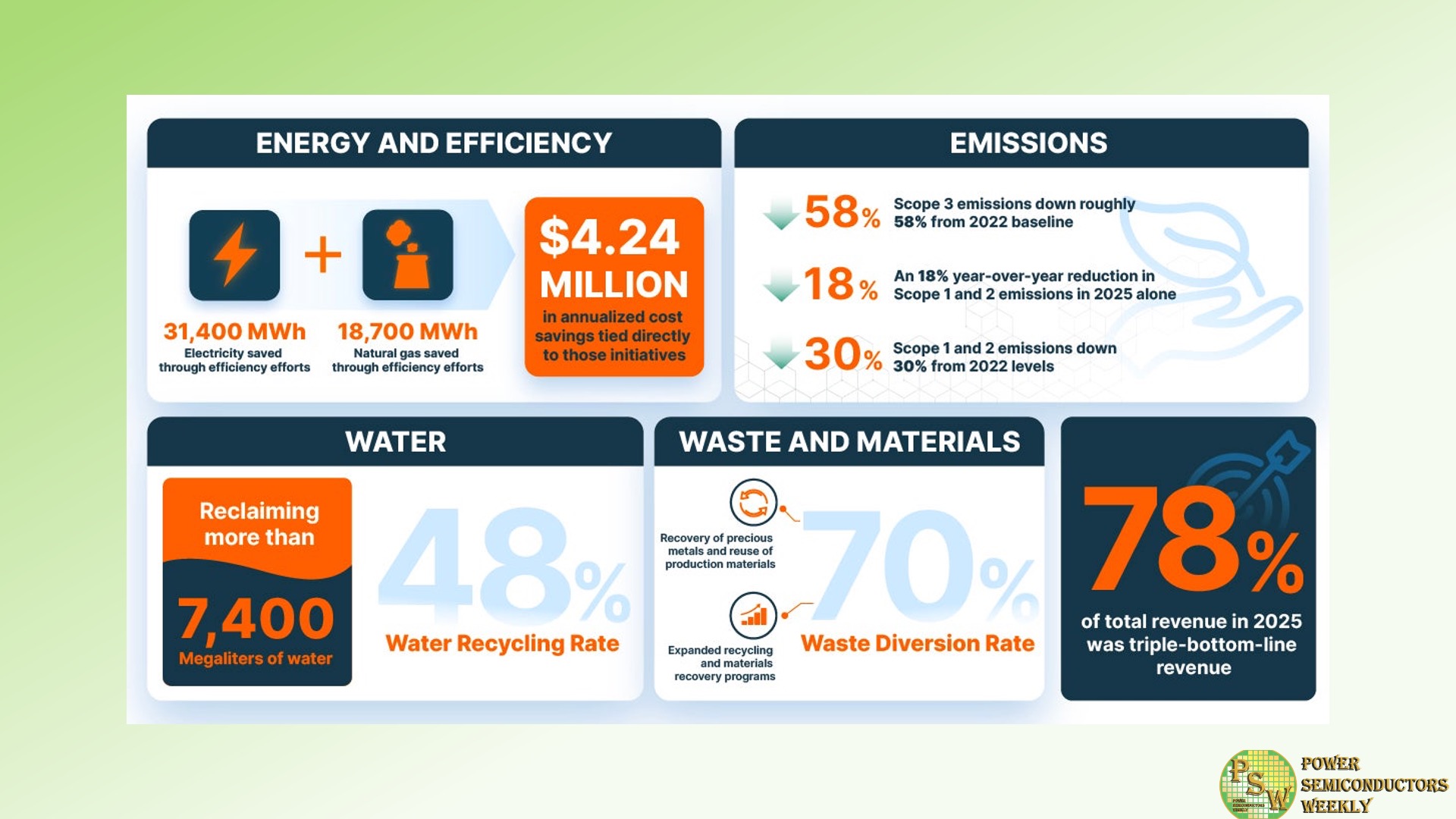
onsemi reported that $4.68 billion, or 78% of its $5.99 billion revenue in 2025, was generated from products aligned with its “triple-bottom-line” strategy, reflecting growing demand for power semiconductors that improve energy efficiency across electric vehicles, renewable energy systems, AI data centers, and industrial applications.
The company also highlighted progress toward its environmental goals, reporting reductions in greenhouse gas emissions, increased water recycling, and operational energy savings as part of its 2025 sustainability performance.
The expansion of AI infrastructure and electrification is driving higher global electricity consumption, increasing demand for semiconductor technologies that reduce power losses and improve system efficiency.
onsemi’s portfolio of intelligent power and sensing solutions is designed to improve energy efficiency in applications such as:
- AI data centers
- Electric vehicles
- Renewable energy systems
- Grid infrastructure
- Industrial power electronics
The company reported significant operational improvements during 2025, including:
- 31,400 MWh of electricity savings
- 18,700 MWh of natural gas savings
- $4.24 million in annualized cost savings from energy efficiency initiatives
According to the company, these efforts reduced both operating costs and environmental impact across its manufacturing operations.
onsemi reported continued progress toward its Net Zero 2040 commitment, including:
- 30% reduction in Scope 1 and Scope 2 emissions compared with its 2022 baseline
- 18% year-over-year reduction in Scope 1 and 2 emissions
- Approximately 58% reduction in Scope 3 emissions from 2022 levels
The company attributed the improvements to manufacturing process enhancements, greenhouse gas abatement technologies, and increased collaboration with suppliers to reduce emissions throughout its value chain.
onsemi has also committed to sourcing:
- 50% renewable electricity by 2030
- 100% renewable electricity by 2040
The company also reported improvements in resource efficiency during 2025:
- 48% water recycling rate
- 7,401 megaliters of water recycled
- 70% waste diversion rate
These initiatives support efforts to reduce freshwater consumption and increase material reuse within semiconductor manufacturing operations.
Products contributing to onsemi’s sustainability-linked revenue include:
- Gate drivers for AI data centers, electric vehicles, and high-power systems
- PowerTrench® T10 MOSFETs for lower conduction and switching losses
- Hybrid IGBT/EliteSiC power modules for higher power density and efficiency
- EliteSiC silicon carbide (SiC) devices for improved efficiency, lower power losses, and enhanced thermal performance
These technologies are designed to improve the efficiency of power conversion systems while reducing overall energy consumption across a range of high-power applications.
Original – onsemi
-

Infineon Technologies and LS ELECTRIC have signed a Memorandum of Understanding (MoU) to jointly develop high-efficiency direct current (DC) power infrastructure for AI data centers, energy storage systems, and next-generation power grids. The collaboration combines Infineon’s semiconductor expertise with LS ELECTRIC’s capabilities in power systems and industrial automation to accelerate the deployment of advanced DC-based power architectures.
The rapid expansion of AI workloads, hyperscale data centers, and digital infrastructure is significantly increasing global electricity demand. At the same time, modern power grids are evolving toward more distributed architectures, driving the adoption of DC power distribution to improve energy efficiency, scalability, and system performance.
The partnership aims to develop semiconductor-enabled DC power solutions capable of supporting these emerging infrastructure requirements.
The collaboration will concentrate on several key technologies for next-generation DC power systems, including:
- Energy storage system (ESS) power conversion
- Solid-state transformers (SSTs)
- Solid-state circuit breakers (SSCBs)
- High-efficiency DC power distribution
- AI data center power infrastructure
- Future smart grid applications
SSTs replace conventional copper and iron transformers with semiconductor-based power conversion technology, delivering:
- Up to 30% smaller and lighter systems
- Higher conversion efficiency
- Improved power management and controllability
Unlike conventional mechanical breakers, SSCBs use semiconductor switches and intelligent protection algorithms to:
- Interrupt fault currents within microseconds
- Improve system protection
- Increase power system reliability
- Enhance availability in high-density DC environments
These technologies are becoming increasingly important for AI data centers and modern distributed energy systems.
Under the agreement:
Infineon will contribute:
- Power semiconductors
- Microcontrollers
- Power control solutions
- Wide-bandgap semiconductor technologies
- System-level power electronics expertise
LS ELECTRIC will contribute:
- Power system engineering
- Industrial automation expertise
- System integration
- Infrastructure implementation
- DC power architecture development
The companies will also align technology roadmaps and pursue joint development activities for future DC infrastructure platforms.
The collaboration addresses a broad range of next-generation energy applications, including:
- AI data centers
- Hyperscale computing facilities
- Energy storage systems (ESS)
- Next-generation power grids
- DC distribution networks
- Industrial power infrastructure
- High-efficiency power conversion systems
Original – Infineon Technologies


